
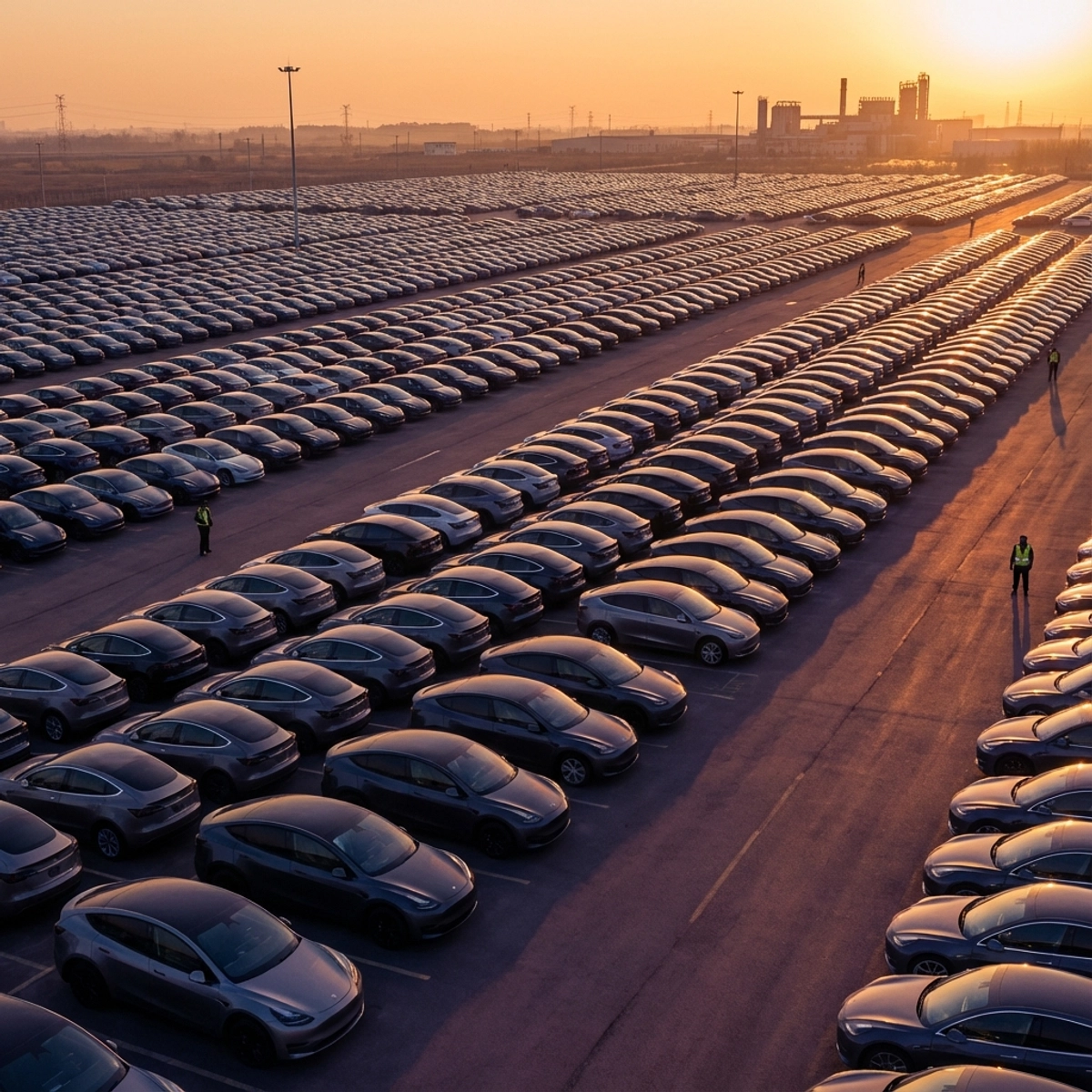
The Hook: The Avalanche Has Started
For the last three years, the automotive industry has been playing a dangerous game of “kick the can.” To move metal during the height of the EV hype cycle (and subsequent cooling), manufacturers leaned heavily on leasing. It was the perfect drug: it lowered monthly payments for consumers and allowed automakers to pass through the $7,500 federal tax credit directly, dodging the strict income and sourcing requirements of the purchase credit.
It worked. EV leasing rates skyrocketed from less than 15% in 2022 to nearly 60% for some brands in 2024.
But a lease is not a sale; it is a rental. And in 2026, the rental period ends.
According to data from J.D. Power and Recurrent Auto, approximately 243,000 electric vehicle leases will mature in 2026. This represents a staggering 230% increase over 2025 volumes. For context, this is more than the entire annual production of some major legacy auto plants.
These aren’t just cars returning to dealerships; they are financial timebombs. Most of these leases were written in 2023, a year when residual values (the estimated value of the car at the end of the lease) were calculated based on the optimistic pricing of the shortage era. The books say these cars should be worth $35,000. The market says they might be worth $20,000.
Someone has to eat that difference. And it won’t be the consumer.
The Deep Dive: The Mathematics of the Crash
To understand why this is a crisis, we need to look at the math of a lease. When a bank or automaker writes a lease, they are effectively making a bet on the future value of the asset.
The Residual Value (RV) is the critical variable. If a bank sets the 3-year residual value of a $50,000 EV at 50% ($25,000), they structure the monthly payments to cover the $25,000 depreciation.
However, if the car comes back in 2026 and is only worth $18,000 at auction, the lessor takes a $7,000 loss on a single vehicle. Multiply that by 243,000 units, and you are looking at a potential $1.7 billion hole in the balance sheets of captive finance arms (like Ford Credit or Hyundai Capital) and major banks.
The “Mark-to-Market” Disaster
This isn’t theoretical. We are already seeing the early tremors. Hertz’s fire sale of its Tesla fleet in 2024 was a preview. They dumped 20,000 EVs onto the market, crashing used Tesla prices by nearly 15% in a single quarter.
In 2026, the volume will be 10x what Hertz unloaded.
The problem is compounded by the Efficiency Paradox. A 2023 Model Y or Mustang Mach-E is significantly less efficient and charges slower than the 2026 models replacing them. Technology in the EV space moves at the speed of smartphones, not combustion engines. A three-year-old iPhone is usable but clearly dated; a three-year-old EV with 250 miles of range and 150kW charging competes against new models with 400 miles of range and 350kW charging.
This technological obsolescence accelerates depreciation far faster than the standard “curve” used for gas cars, which haven’t fundamentally changed in a decade.
The Players: Who Holds the Bag?
So, who pays?
1. The Captives (The Automakers)
For brands like Tesla, Ford, and Hyundai, the risk sits on their specific finance subsidiaries. If Ford Credit takes a bath on Mach-E residuals, it hits Ford’s bottom line directly. This creates a perverse incentive: automakers might try to “prop up” used values by refusing to send cars to auction, instead channeling them into “Certified Pre-Owned” programs or internal subscription fleets.
2. The Banks (Ally, Chase, U.S. Bank)
Banks that underwrote independent leases are in a tougher spot. They don’t have dealerships to re-market the cars. They effectively have to dump them at auction (Manheim or Adesa). If they flood the auction lanes, they crash the price for everyone, including the automakers. It’s a prisoner’s dilemma: the first one to sell loses the least.
3. The Lessees (You?)
Surprisingly, the lessee is the winner here. You walk away. You hand over the keys and the problem becomes someone else’s. In fact, you might be able to buy your own car back for thousands less than the contract residual price, as banks would rather negotiate with you than pay shipping and auction fees to realize a guaranteed loss.
The Opportunity: The “Bargain of the Century”
While this is a nightmare for CFOs, it is the buying opportunity of a lifetime for Gen Z and Millennial drivers priced out of the new car market.
The $25,000 Sweet Spot
The magic number in the used EV market is $25,000. Under U.S. tax law (Section 25E), used EVs purchased from a dealer for $25,000 or less qualify for a $4,000 tax credit.
Currently, many 2022/2023 EVs are hovering just above this threshold. The 2026 supply glut will almost certainly push models like the Tesla Model 3 Long Range, VW ID.4 Pro, and Ford Mustang Mach-E Premium deeply into sub-$25,000 territory.
Do the math:
- Listing Price: $24,500
- Used EV Tax Credit: -$4,000 (Point of Sale)
- Net Cost: $20,500
For $20,500, a buyer gets a modern, low-maintenance vehicle that beats 90% of gas cars off the line. This is the moment effectively predicted by Wright’s Law: volume drives cost down. It’s just happening in the used market first.
The Battery “Fear Factor”
The biggest counter-argument is always the battery. “What if it fails?”
This fear is largely overstated, according to data from Recurrent Auto. Their analysis of 20,000+ vehicles shows that modern liquid-cooled battery packs (post-2020) are degrading far slower than early Nissan Leafs. Most are retaining 90%+ capacity well past 100,000 miles.
Furthermore, Federal law mandates an 8-year/100,000-mile warranty on EV batteries. A 2023 model bought used in 2026 still has 5 years and 60,000+ miles of warranty coverage remaining on the most expensive component. That represents a warranty “safety net” that is virtually unheard of in the used combustion engine market (where a 3-year-old BMW is often out of bumper-to-bumper warranty).
Strategic Analysis: The Future of Ownership
The 2026 Lease Cliff will fundamentally break the traditional ownership model for EVs. We are moving toward a consumer electronics lifecycle.
The “Second Tier” market is forming. Just as there is a robust market for used iPhones or refurbished MacBooks, the used EV market will mature into a standardized, high-volume ecosystem. We expect to see the rise of specialized “Battery Certificate” providers who act like home inspectors, giving independent verification of State of Health (SoH) to calm buyer nerves.
For the automakers, the lesson is painful but necessary: stop treating EVs like appreciating assets. The deflationary nature of technology has finally come for the driveway.
What You Should Do
- If you are leasing now: Do not buy out your lease today. Wait. The market value is likely far lower than your residual. Negotiate at the end of the term.
- If you want to buy: Wait until Q2 2026. The inventory wave will hit, dealers will be desperate to clear lots, and prices will find a new floor.
- If you invest: Short the auto lenders exposed to high volumes of 2023 vintage leases. The write-downs are coming.
The transition to electric was never going to be a straight line. 2026 will be a heavy correction, a clearing of the books that re-prices the entire sector. It will be brutal for the spreadsheet jockeys in Detroit and Tokyo, but for the average driver looking for cheap, reliable transportation? It might just be the best news in years.



🦋 Discussion on Bluesky
Discuss on Bluesky