
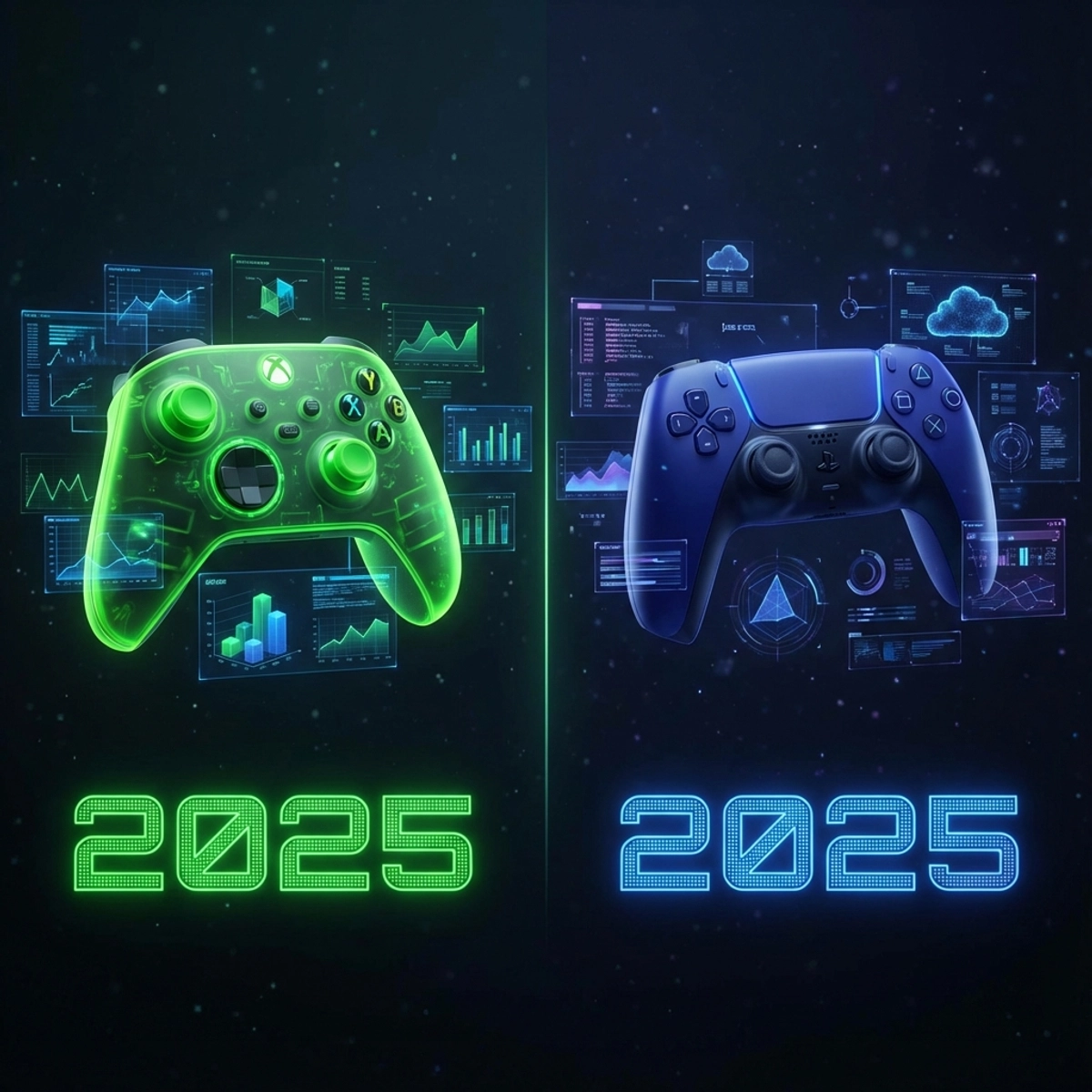
The ritual has arrived. Every December, millions of gamers eagerly (or nervously) await the judgment of the algorithm. It’s not just a summary of hours played; it’s a digital mirror reflecting our habits, our obsessions, and yes, that embarrassing amount of time we spent in The Sims 4 menu while doing scrolling TikTok.
On December 9, 2025, both Sony and Microsoft dropped their respective annual recaps: the PlayStation Wrap-Up and Xbox Year in Review. While they share a common goal—gamifying your own data to encourage social sharing—their approaches, specific metrics, and underlying design philosophies are strikingly different this year.
In this deep dive, we aren’t just looking at the flashy cards. We’re analyzing the “how” and “why” behind these viral marketing juggernauts, exploring the specific data points they track, the technical architecture required to query petabytes of gaming logs, and what the removal of key features (RIP PlayStation’s monthly breakdown) signals about the future of engagement tracking.
The Tale of the Tape: Features Comparison
At a glance, both platforms offer the basics: total hours, top games, and achievements. But the devil is, as always, in the metadata. The 2025 iterations reveal where each company is placing its bets: Xbox on ecosystem breadth (Game Pass, Cloud, PC), and PlayStation on focused, console-centric experiences.
| Feature | PlayStation Wrap-Up 2025 | Xbox Year in Review 2025 |
|---|---|---|
| Availability | Dec 9, 2025 - Jan 8, 2026 | Dec 9, 2025 - Jan 31, 2026 |
| Primary Metric | ”Gaming Style” Archetype | ”Gamer Profile” Title |
| Deep Stats | Accessory usage (VR2, Portal) | Game Pass vs. Owned breakdown |
| Social Sharing | Digital Cards | Digital Cards + Stat Sheets |
| Rewards | Exclusive Avatar | None |
| Missing Feature | Monthly Breakdown | Detailed PC/Cloud separation |
The “Identity” Engine: Defining Who You Are
Both platforms have leaned heavily into “Gaming Personalities” this year, moving away from raw spreadsheets toward persona-based categorization. This shift is psychological: users are more likely to share a label that “defines” them than a raw number.
Xbox assigns you a title like “Knight Owl” (signifying late-night gaming sessions) or “Real MVP” (high completion rates). This utilizes time-stamped session data to infer lifestyle habits, not just gaming preferences. If you play predominantly between 11 PM and 3 AM, the algorithm flags you as a nocturnal gamer. If you play snippets of 30+ games for less than an hour each, you might get a “Taste Tester” tag. This requires a level of temporal data analysis that goes beyond simple “time played” accumulators.
PlayStation, conversely, focuses on genre dominance. Their “Gaming Style” is calculated based on the percentage of playtime across predefined genre buckets (Action, RPG, Sports, Shooter). It’s a cleaner, albeit simpler, look at what you play, rather than how you play. A user with 80% playtime in Elden Ring and Final Fantasy VII Rebirth is branded an “Adventure Seeker,” while the Call of Duty and FC 25 regular is a “Competitive Spirit.” It simplifies taste into palatability, making it easier to share, but perhaps less insightful than Xbox’s behavioral analysis.
The Mechanics of “Wrapped”: How They Watch You
How does this actually work? It feels like magic, but it’s really just the world’s most detailed surveillance system, dressed up in a party hat.
The “Digital Receipt”
Think of your console like a grocery store register. Every single thing you do generates a “receipt” on Sony and Microsoft’s servers.
- The Check-In: When you boot up Call of Duty, your console punches a time card.
- The Action: When you unlock a trophy or finish a level, it adds a line item to that receipt.
- The Pause Problem: One of the biggest complaints gamers have is “inflated hours.” This happens because the system struggles to tell the difference between “playing” and “paused.” Unless a developer specifically tells the console “Hey, they are in the menu,” the timer keeps ticking. That 100-hour RPG playthrough? It might be 70 hours of gaming and 30 hours of leaving the game running while you made dinner.
Why We Lost the Monthly Breakdown
Generating these reports for 100+ million users is incredibly expensive. It requires sifting through billions of those “digital receipts.”
- The Cost of Nostalgia: PlayStation removing the monthly breakdown this year is likely a cost-cutting measure. Calculating your stats month-by-month requires 12 times more processing power than just giving you a single “Year Total.”
- The “Cold” Storage: To save money, companies move your old gaming data into “deep storage” (basically a cheaper, slower digital warehouse) after a few days. Bringing that data back out to analyze your specific activity in March 2025 takes time and money. By simplifying the report, they save millions in server costs. It’s a business decision that unfortunately makes the user experience worse.
Contextual History: The Spotify Effect
We cannot talk about gaming wrap-ups without acknowledging Spotify Wrapped. When Spotify launched the format in 2016, it changed digital marketing data from a “privacy concern” to a “status symbol.”
Before Wrapped, companies were terrified of showing users how much data they collected. The “Shadow Profiles” scandals of the early 2010s made “tracking” a dirty word. Spotify flipped the script by making the data cute. They proved that users will forgive surveillance if the output feeds their ego.
Gaming companies were slow to adapt, fearing backlash about “addiction” metrics.
- 2018: PlayStation introduces rudimentary yearly stats, mostly focused on Trophies.
- 2020: Xbox follows suit, but the data was messy and often inaccurate.
- 2023: Nintendo enters the fray with a simpler Switch Year in Review, proving even the most privacy-conservative company saw the value.
- 2025: The format is now standardized industry-wide, acting as the single largest organic social media marketing day for these companies.
Why It Matters: This is “User Generated Content” (UGC) weaponized. Users aren’t just sharing stats; they are advertising the platform. A stylized card showing “500 Hours on PS5” is a more effective ad for the console’s stickiness than any billboard. It signals to your friends: “I am invested here. Come join me.”
Forward-Looking Analysis: The Gamification of Life
What’s next for these systems? The trend line points toward Predictive Analytics, Real-Time Integration, and deeper AI synthesis.
The 2026 Prediction: AI Narratives
We expect next year’s iterations to leverage AI agents (like the ones currently rolling out in Google Cloud and Azure) to provide narrative summaries. Instead of static text “You played a lot of RPGs,” an LLM could generate a unique paragraph: > “You started 2026 as a space explorer in ‘Starfield’, but specific telemetry shows you kept crashing your ship. By March, you pivoted to ‘Forza Motorsport’, likely creating a safer driving environment. Your summer was defined by 200 hours of ‘Hades II’, proving you really enjoy repetitive punishment.”
This shift from “Stats” to “Story” is the next frontier. It requires running an LLM inference for every user, which is expensive today, but likely trivial by December 2026.
The Privacy Trade-Off: Heatmaps and Eye Tracking
As hardware evolves, so does the tracking. With the PS VR2 offering eye-tracking, Sony theoretically knows exactly where you looked in a game scene. Did you stare at the explosion or the character’s face? In 2025, we are already seeing “Heatmaps” in esports reviews—showing exactly where on the map a player died most often. It is not a stretch to imagine “Wrapped 2027” including a heatmap of your deaths in distinct games.
While fascinating, this blurs the line between “fun recap” and “surveillance.” Xbox’s “Knight Owl” tag is fun, but it also confirms they have granular data on your sleep schedule. If they know you are gaming at 4 AM, they know you aren’t sleeping. That data puts them one step away from health insurance logic—“User displays irregular sleep patterns.”
For now, we enjoy the shiny cards. But as we head into 2026, remember: if you’re not paying for the product, you (and your data) are the product. In this case, we paid $500 for the console, and we’re still the product.
Verdict
For 2025, Xbox takes the win on depth. The specific inclusion of granular cloud/Game Pass stats and the behavioral inference of “Gamer Profiles” offers a more interesting look at how you play, not just what.
PlayStation wins on presentation. The UI is slicker, the animations are smoother, and the tangible reward of an exclusive avatar gives users a permanent memento. However, the loss of the monthly breakdown is a significant blow to the utility of the tool for dedicated players who want to track their chronological journey.
Ultimately, both tools serve their purpose: they make us feel accomplished for spending a month of our lives holding a plastic controller. And really, isn’t that what gaming is all about?
Now, if you’ll excuse me, I need to explain to my editor why I have 400 hours in ‘PowerWash Simulator’ and zero in ‘Excel’.



🦋 Discussion on Bluesky
Discuss on Bluesky