

Points clés
- Le pétrole est une dépendance, non l’indépendance : 66,6 % du pétrole américain va aux transports, canalisé à travers seulement 129 raffineries que vous ne posséderez jamais.
- Solaire + batterie + VE est le premier vrai chemin vers l’autosuffisance énergétique : Un système solaire de toit produit l’électricité à environ $0,05–0,08/kWh après incitations, contre la moyenne résidentielle du réseau de 17,45 cents/kWh en janvier 2026.
- La longévité des batteries est meilleure que celle annoncée : Les dernières batteries de CATL conservent 80 % de capacité après 3 000 cycles, et leur chimie sodium-ion dépasse 10 000 cycles.
- Le parallèle de 1935 est exact : L’administration de l’électrification rurale a prouvé que l’énergie distribuée nécessite un financement organisé. Sans un équivalent moderne, l’autosuffisance énergétique reste un privilège de la classe propriétaire.
Le mythe qu’on vous a vendu
Quelque part entre une publicité Dodge Ram et un marathon Landman sur Paramount+, la définition américaine de l’« indépendance énergétique » a été détournée. Le récit culturel est clair : les vrais Américains forent. Les vrais Américains conduisent des V8. Les vrais Américains n’ont besoin de personne (surtout pas du gouvernement) leur dire comment alimenter leurs vies.
Il y a juste un problème avec cette histoire. C’est une inversion complète de la réalité.
L’Américain moyen qui remplit à la pompe participe à l’une des chaînes d’approvisionnement les plus centralisées et géopolitiquement fragiles de la Terre. Ce gallon d’essence a parcouru une chaîne de possession qui commence dans un champ pétrolifère étranger, traverse un océan sur un pétrolier qui pourrait être bloqué par une marine hostile unique, arrive à l’une des seulement 129 raffineries de pétrole opérationnelles aux États-Unis et est livré à une station de vente au détail qui augmente le prix en fonction de ce que l’OPEP a décidé le mois dernier.
Ce n’est pas l’indépendance. C’est une dépendance avec un chapeau de cow-boy dessus.
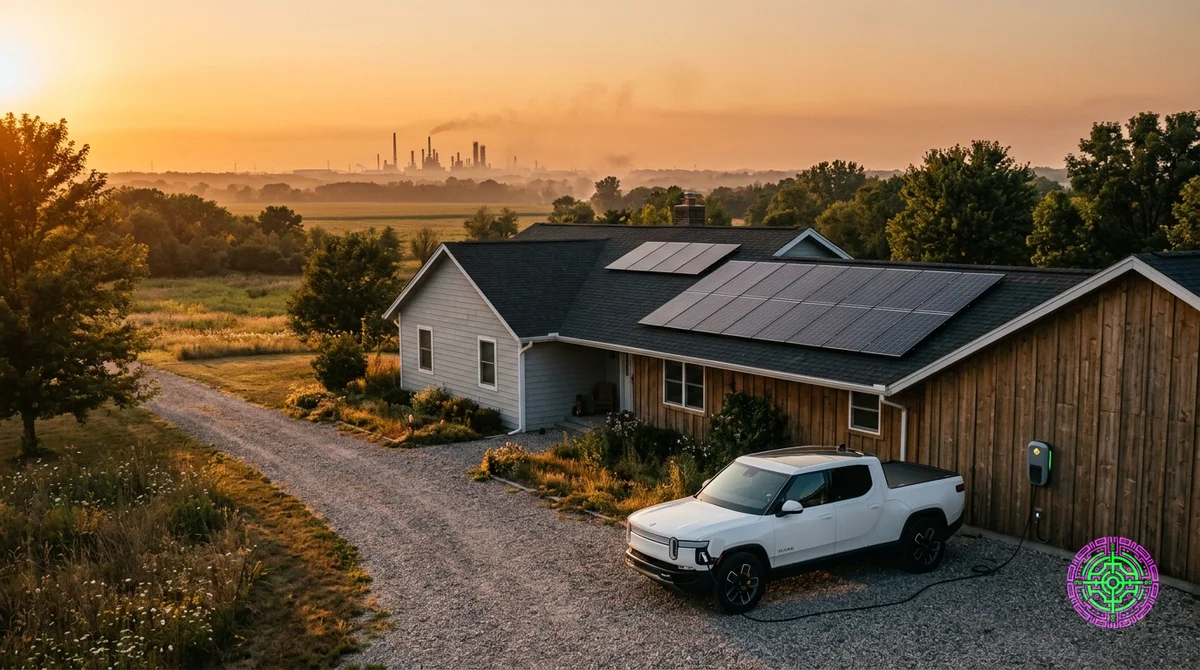
Pendant ce temps, le soleil frappait votre toit gratuitement. Personne ne l’a embargoé. Aucun cartel a fixé le prix. Aucun pipeline n’a fui dans votre eau souterraine. Et si vous aviez un tableau solaire, une batterie et un véhicule électrique (VE), vous auriez converti cette lumière solaire libre en électricité qui alimente votre maison et votre trajet, sans demander la permission de qui que ce soit.
Les chiffres qui tuent le mythe du pétrole
Les mathématiques ne sont pas subtiles. En janvier 2026, le prix moyen de l’électricité résidentielle aux États-Unis a atteint 17,45 cents par kilowatt-heure (kWh), une augmentation de 9,5 % par rapport à janvier 2025. Les factures d’électricité ont augmenté plus vite que l’inflation dans plus de 80 % des États américains en 2025, avec des augmentations dépassant 2,5 fois le taux de croissance de l’indice des prix à la consommation (IPC) général.
Ce sont les coûts de rester sur le réseau et d’espérer que votre compagnie d’électricité garde les lumières allumées à un prix raisonnable. Voici l’alternative.
Un système solaire de toit résidentiel aux États-Unis coûte approximativement $2 854 par kilowatt de courant continu (kW-CC) installé, selon l’administration de l’information énergétique (EIA) citant les références du laboratoire national d’énergies renouvelables (NREL). Pour un système typique de 8 kW, c’est environ $22 800 avant le crédit d’impôt à l’investissement fédéral de 30 % (ITC), ou environ $16 000 après. Sur une période de garantie de 25 ans (et les panneaux modernes devraient de plus en plus fonctionner bien au-delà de 30 ans), ce système produit de l’électricité à un coût levelisé de l’énergie (LCOE) entre $0,05 et $0,08 par kWh.
Comparez cela aux 17,45 cents/kWh que vous payez au service public.
Le panneau solaire ne se soucie pas de qui est président. Il ne se soucie pas des réductions de production de l’OPEP, des pannes de raffinerie au Texas ou des pics de prix du gaz naturel entraînés par la demande des centres de données en intelligence artificielle (IA) mangeant le réseau. Il convertit simplement les photons en électrons, chaque jour, sur un toit que vous possédez déjà.
La batterie change tout
Le solaire seul a une faiblesse évidente : le soleil se couche. Ce n’est pas une nouvelle. Mais ce qui est nouveau, c’est la rapidité avec laquelle les économies de batterie ont changé.
La batterie 5C de CATL, présentée en janvier 2026, conserve 80 % de sa capacité après 3 000 cycles de charge-décharge complets, équivalent à approximativement 1,8 million de kilomètres de conduite. Séparément, leur batterie sodium-ion Tianxing II pousse la vie en cycles au-delà de 10 000 cycles avec une capacité de 45 kWh et une densité énergétique de 175 watt-heures par kilogramme (Wh/kg). La chimie du phosphate de fer lithié (LFP), le type utilisé dans la plupart des batteries domestiques incluant le Tesla Powerwall, atteint régulièrement 3 000 à 5 000 cycles dans les produits commerciaux.
Une batterie domestique utilisant la chimie LFP, cyclée une fois par jour, dure plus de huit ans avant d’atteindre 80 % de capacité et continue de fonctionner bien au-delà de ce seuil. Le sodium-ion prolonge cela à près de 27 ans de cyclage quotidien. Ce ne sont pas des résultats de laboratoire théoriques. CATL produit les deux chimies en masse maintenant.
L’implication pratique : un propriétaire avec énergie solaire sur le toit et une batterie domestique peut stocker la génération diurne pour l’utilisation du soir, réduisant dramatiquement ou éliminant la dépendance au réseau. Ajoutez un VE avec capacité de charge bidirectionnelle (Véhicule-à-réseau, ou V2G), et la voiture elle-même devient une batterie secondaire, une centrale électrique roulante stationnée dans l’allée.
L’avantage du TCO du VE renforce le cas. Sur une période de possession de cinq ans, les VE économisent estimé $6 000 à $14 000 par rapport aux véhicules à essence équivalents, avec 40 à 60 % de coûts de maintenance plus bas. Pas de changement d’huile. Pas de fluide de transmission. Pas de système d’échappement à rouille. Les plaquettes de frein durent considérablement plus longtemps parce que le freinage par récupération fait la plupart du travail.
Pour quiconque a conduit un VE puis grimpé dans une voiture à essence, l’écart d’expérience est viscéral. Couple instantané. Accélération silencieuse. Pas de délai entre intention et mouvement. Revenir à un moteur à combustion interne ressemble à passer d’un smartphone à un téléphone rotatif. Cela fonctionne techniquement, mais vous ressentez chaque année de progrès manquée.
Le problème de la raffinerie
Voici l’argument structural que la foule « forer bébé forer » n’adresse jamais.
Les États-Unis ont consommé approximativement 20,28 millions de barils de produits pétroliers par jour en 2022. Les transports représentaient 66,6 % de cette consommation, environ 13,5 millions de barils quotidiens, avec la seule essence automobile à 8,78 millions de barils par jour.
Avant que les défenseurs du pétrole commencent à composer leurs commentaires : oui, le pétrole n’est pas juste de l’essence. Il y a le bitume, les produits pharmaceutiques, les tissus synthétiques, les engrais, les lubrifiants et les plastiques. Le nombre stupéfiant de produits dérivés des hydrocarbures est véritablement stupéfiant, et personne de sérieux ne soutient que le pétrole disparaît complètement de l’économie. Mais cet argument, bien que factuellement correct, est une diversion du point structural. Les 66,6 % de la consommation pétrolière qui vont aux transports ne font pas votre bouteille d’eau en plastique ou votre veste en polyester. C’est brûlé, une fois, pour déplacer un véhicule du point A au point B. C’est la portion que le solaire, les batteries et les VE remplacent. La chaîne d’approvisionnement pétrochimique et la chaîne de carburant de transport sont des conversations différentes, et les confondre est comment l’industrie évite celle qu’elle perd.
Tout ce carburant de transport passe par 129 raffineries. L’installation la plus grande unique, Motiva Enterprises à Port Arthur, au Texas, traite 626 000 barils par jour. Le Texas seul représente près de 6 millions de barils par jour de capacité de raffinage.
Ce n’est pas un système distribué. C’est un goulot d’étranglement. Un ouragan, une cyberattaque, une grève du travail ou un seul événement géopolitique dans le détroit d’Ormuz peut envoyer les prix de l’essence en spirale, et il n’y a rien que le consommateur individuel puisse faire sauf payer plus.
Personne n’a de raffinerie dans sa cour arrière. Mais environ 66 % des Américains possèdent leur maison, et chacune de ces maisons a un toit. Le soleil ne nécessite pas un pipeline, un pétrolier ou une escorte de sécurité à travers les eaux contestées. Il nécessite des panneaux, du câblage et un onduleur.
La chaîne d’approvisionnement des combustibles fossiles est un chef-d’œuvre d’ingénierie centralisée. C’est aussi un chef-d’œuvre de vulnérabilité centralisée. Chaque maillon de la chaîne (extraction, transport, raffinage, distribution) est un point de défaillance que le consommateur ne peut pas contrôler, contourner et ne peut pas refuser.
Le solaire est l’architecture opposée. C’est radicalement distribué. Chaque toit est une centrale électrique. Chaque batterie domestique est une réserve. Chaque VE est une unité de stockage mobile. La défaillance du système d’un ménage n’affecte personne d’autre. Il n’y a pas un seul point qu’un adversaire, étranger ou domestique, peut cibler pour mettre hors ligne l’approvisionnement énergétique de millions de personnes.
Le parallèle de 1935 dont personne ne parle
En 1935, seulement environ 10 % des fermes américaines avaient l’électricité. Les services publics privés ont refusé de câbler les zones rurales parce que ce n’était pas suffisamment rentable : trop de miles de ligne pour trop peu de clients. Le marché avait parlé, et le marché a dit que les agriculteurs pouvaient rester dans l’obscurité.
Le président Franklin D. Roosevelt n’a pas accepté ce verdict. L’administration de l’électrification rurale (REA) a été créée par décret exécutif le 11 mai 1935 et formalisée par la loi sur l’électrification rurale du 20 mai 1936. L’REA a offert des prêts à faible intérêt aux coopératives, des groupes d’agriculteurs qui se sont organisés pour construire et posséder leurs propres lignes de distribution. En 1939, plus de 350 coopératives s’étaient formées, plus de 350 000 miles de ligne avaient été construits et environ 640 000 fermes avaient l’électricité.
Le parallèle avec 2026 est inconfortable dans sa précision. Les services publics combattent le solaire sur toit et la facturation nette de la même manière que les services publics privés ont combattu l’électrification rurale dans les années 1930, parce que la génération distribuée menace le modèle commercial du monopole. Quand un propriétaire génère sa propre électricité, le service public perd un client. Quand ce propriétaire revend l’excédent d’électricité au réseau, le service public perd deux fois.
La transition de la mesure nette d’énergie 2.0 (NEM 2.0) à la NEM 3.0 de Californie a réduit la valeur de l’énergie solaire exportée d’environ 75 %, une décision que les critiques soutiennent a été entraînée par le lobbying des services publics, pas l’économie du réseau. Des retours en arrière de mesure nette similaires ont été proposés ou promulgués dans plusieurs États, tandis que plusieurs États manquent complètement de mesure nette obligatoire. Le schéma est cohérent : les services publics soutiennent que les clients solaires ne paient pas leur « juste part » de l’entretien du réseau, tandis que les défenseurs solaires soutiennent que la génération distribuée réduit le besoin d’infrastructure de réseau coûteuse en premier lieu.
La question de 1935 était : chaque Américain mérite-t-il l’électricité, ou seulement ceux que le marché trouve rentable de servir ? La question de 2026 est identique : chaque Américain mérite-t-il l’autosuffisance énergétique, ou seulement ceux qui peuvent se permettre le coût initial ?
La barrière honnête : vous devez d’abord avoir une maison
C’est là que l’aspiration entre en collision avec la barrière structurelle, et l’honnêteté intellectuelle l’exige que nous la reconnaissions.
Le prix médian d’une maison américaine reste à ou près des sommets historiques. Environ un tiers des Américains sont locataires, et les locataires ne peuvent pas installer de solaire sur le toit. Ils ne peuvent pas installer de batteries domestiques. Ils ne peuvent pas brancher un VE dans une allée qu’ils ne possèdent pas. Toute la pile solaire-batterie-VE d’autosuffisance suppose la propriété d’une maison, et la propriété d’une maison en 2026 est elle-même de plus en plus un marqueur de classe.
C’est la zone grise avec laquelle les partisans enthousiastes des deux côtés refusent de s’engager. Les défenseurs du pétrole soulignent le coût initial du solaire et des batteries et disent « Voyez ? C’est un jouet pour les riches. » Les défenseurs solaires contre-attaquent avec les mathématiques d’économies de vie entière et disent « Cela se paie en lui-même. » Les deux ont raison. Les deux sont incomplets.
Le coût initial d’un système solaire plus batterie, même après l’ITC de 30 %, atteint $20 000 à $35 000 selon la taille du système et les coûts d’installation locaux. C’est du vrai argent. Pour un propriétaire avec équité et un revenu stable, c’est un investissement qui paie des dividendes pendant des décennies. Pour un locataire ou un propriétaire étiré par une hypothèque aux taux actuels, c’est inaccessible.
Il y a un contournement partiel : l’auto-installation. Les coûts solaires résidentiels incluent des coûts logiciels importants (permis, travail, frais généraux des entrepreneurs et marges bénéficiaires) qui peuvent représenter environ la moitié du prix total installé. Un propriétaire disposé et capable de monter les panneaux, de passer les gaines et de câbler un onduleur peut réduire considérablement le coût du système en achetant l’équipement directement et en faisant le travail physique. Les kits solaires DIY sont largement disponibles. Le compromis est réel : les travaux électriques nécessitent des permis et des inspections dans la plupart des juridictions, les systèmes montés sur toit comportent un risque de chute et le câblage incorrect peut annuler les garanties ou créer des risques d’incendie. Mais pour le propriétaire mécaniquement enclin, l’auto-installation rend les mathématiques fonctionnelles à des niveaux de revenu plus bas.
Même les propriétaires qui dépassent la barrière financière font face à une deuxième barrière : la politique étatique hostile. Selon l’analyse de l’EIA des politiques au niveau des États, plusieurs États, dont l’Alabama, le Mississippi, le Tennessee, le Dakota du Sud, l’Idaho et le Texas, manquent de requirements de mesure nette obligatoires. En Alabama, le plus grand service public de l’État n’offre pas de mesure nette. Les clients solaires qui exportent l’électricité excédentaire au réseau obtiennent peu ou pas de crédit pour cela. La Commission du service public de l’État a historiquement garanti au service public un taux de rendement fixe, créant une structure réglementaire où le service public profite quel que soit le produit dont ont besoin les clients. Le résultat est un État où vous pouvez installer des panneaux solaires sur votre toit, mais le cadre réglementaire le décourage activement. Quand votre gouvernement d’État protège les profits des services publics de la concurrence par ses propres clients, le mot pour cela n’est pas « marché libre ». C’est la capture réglementaire.
C’est précisément pourquoi le parallèle de 1935 importe. L’REA n’a pas rendu l’électricité bon marché dans un avenir abstrait. Elle a créé le mécanisme de financement (prêts coopératifs à faible intérêt) qui l’a rendue accessible maintenant. La technologie existait. L’économie fonctionnait à l’échelle. Ce qui manquait était le capital organisé pour combler le coût initial pour les gens qui ne pouvaient pas s’auto-financer.
Les programmes d’énergie solaire communautaire, les banques vertes et le financement via l’évaluation des biens immobiliers propres (PACE) sont des tentatives initiales d’un équivalent moderne. Mais ils restent fragmentés, État par État et politiquement contestés. Il n’y a pas d’« administration fédérale de l’électrification solaire » avec le mandat et le capital pour faire pour l’énergie distribuée ce que l’REA a fait pour l’électricité rurale.
La propagande et la physique
La dimension culturelle mérite un examen honnête. Les séries comme Landman (Paramount+, novembre 2024) dépeignent l’industrie pétrolière à travers une lentille humaine sympathique : les travailleurs, les pressions financières, les coûts personnels. C’est du storytelling légitime. Les travailleurs des champs pétrolifères sont des gens réels faisant des travaux dangereux sur lesquels l’économie dépend actuellement.
Mais le vide analytique de la série, noté par les critiques de Variety à Rolling Stone aux organisations environnementales, est l’absence de contrepoids. Le récit présente l’extraction pétrolière comme un acte héroïque d’autosuffisance américaine sans engager la réalité structurelle que les consommateurs de pétrole sont parmi les personnes les moins autosuffisantes dans l’économie énergétique. Vous comptez sur un marché des produits de base mondiaux, un secteur raffinage concentré et un réseau de distribution qui se casse chaque fois qu’un ouragan frappe la Côte du Golfe.
L’ironie est que l’identité culturelle la plus associée à l’autosuffisance (l’Américain rural, l’agriculteur, l’éleveur, l’homesteader) est l’identité la mieux positionnée pour bénéficier du stockage solaire et des batteries. Les propriétés rurales ont la terre et l’exposition solaire dégagée. Les opérations agricoles ont de grandes demandes énergétiques prévisibles. Le même individualisme farouche que le marketing du pétrole co-opte est précisément l’éthos que l’indépendance solaire-batterie livre réellement.
La physique ne ment pas et ne se soucie pas des tribus politiques. Le rayonnement solaire frappe chaque État. Les panneaux photovoltaïques (PV) cristallins modernes se dégradent à environ 0,5–0,6 % par an, déclinant vers 0,33 % par an d’ici 2035 à mesure que la fabrication s’améliore. Un panneau installé en 2026 produira toujours plus de 80 % de sa puissance nominale en 2056. Les puits de pétrole s’épuisent. Les panneaux solaires continuent juste.
Ce qui vient ensuite
La convergence de trois tendances s’accélère :
Coûts du réseau en hausse : Les prix de l’électricité résidentielle ont grimpé de 9,5 % d’année en année et devraient continuer à augmenter alors que les services publics investissent dans l’infrastructure pour soutenir la demande des centres de données IA et le durcissement du réseau. Chaque augmentation de tarif rend la période de remboursement solaire plus courte.
Chute des coûts des batteries : Les chimies LFP et sodium-ion font chuter les coûts des batteries domestiques tout en prolongeant dramatiquement la durée de vie des cycles. À mesure que les fabricants de batteries EV (CATL, BYD, Samsung SDI) produisent à l’échelle, la capacité excédentaire est redirigée vers le stockage résidentiel, la même dynamique qui a fait monter en flèche les batteries domestiques en 2025.
Pression politique : L’expiration et le retrait potentiel des incitations de l’énergie propre fédérale crée un paradoxe. Éliminer l’ITC rend le solaire plus cher à l’avance, mais l’augmentation simultanée des prix de l’électricité rend les économies de vie entière plus grandes. Le signal du marché pour l’auto-génération n’augmente que davantage à mesure que les prix du réseau grimpent.
La pièce manquante est l’infrastructure de financement. Jusqu’à ce qu’il y ait un mécanisme organisé et accessible pour les propriétaires non-riches (et les locataires, via l’énergie solaire communautaire) de participer, l’autosuffisance énergétique restera ce que la propriété d’une maison elle-même est devenue : un marqueur de qui a obtenu une place suffisamment tôt.
Le résultat net
Le pétrole ne vous a jamais rendu indépendant. Il vous a rendu client du système énergétique le plus centralisé et géopolitiquement vulnérable jamais construit. Chaque gallon que vous pompez est un vote de confiance dans 129 raffineries, le calendrier de production de l’OPEP et la sécurité physique des routes de transport que vous ne pouvez pas voir.
Le solaire, les batteries et les VE ne sont pas parfaits. Les coûts initiaux sont réels. Les chaînes d’approvisionnement minérales ont leurs propres vulnérabilités. La vie hors réseau complète reste impractique pour la plupart. Et le pétrole restera nécessaire pour les matières premières industrielles, les plastiques et les transports lourds pendant des décennies.
Mais pour l’aspiration américaine fondamentale d’alimenter votre maison, de conduire votre véhicule et de ne pas être à la merci de forces au-delà de votre contrôle, la technologie existe, l’économie fonctionne et la physique est de votre côté. La seule chose qui manque est ce qui manquait en 1935 : la volonté politique de le rendre accessible à tous, pas seulement aux gens qui peuvent déjà se le permettre.
Tout le monde a la lumière du soleil. La question est si tout le monde a le droit de l’utiliser.
Nos sources
- EIA Electricity Monthly Update - End Use (January 2026)
- EIA - Use of Oil and Petroleum Products
- EIA - Petroleum Data and Statistics
- S&P Global - Electricity Affordability at a Crossroads
- S&P Global - CATL Fifth-Generation LFP Battery
- EIA - Distributed Generation and Storage Cost Assumptions
- EIA - Residential Demand Module AEO 2025
- S&P Global - Electricity Bills Rising Faster Than Inflation
🦋 Discussion on Bluesky
Discuss on Bluesky