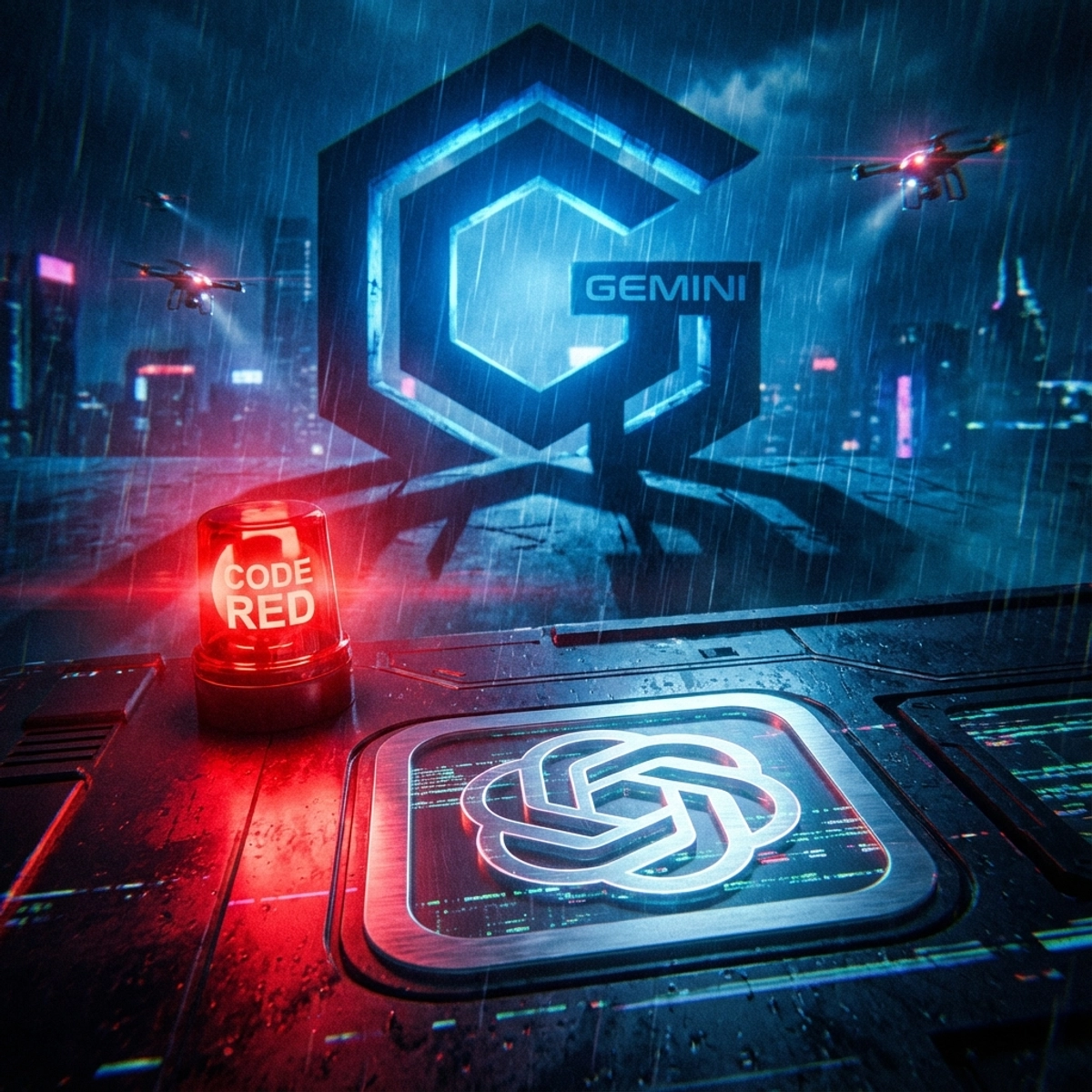
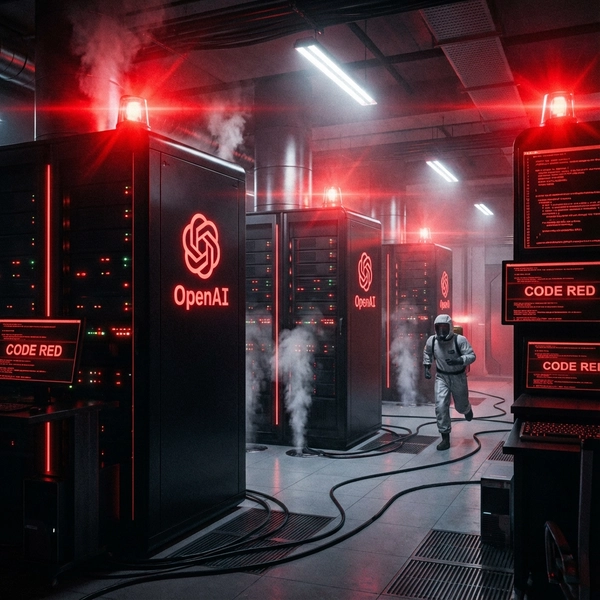
The tables have turned. In early 2023, it was Google issuing a “Code Red”—scrambling to respond to the sudden dominance of ChatGPT. Fast forward to December 2025, and the alarm bells are ringing in San Francisco, not Mountain View.
Following the blockbuster release of Google’s Gemini 3—which has decisively topped every major AI benchmark from MMLU-Pro to HumanEval-X—OpenAI CEO Sam Altman has reportedly declared his own internal “Code Red.” The mandate? Drop everything that isn’t core to ChatGPT’s survival.
With a rumored December 9th release date for GPT-5.2, the question isn’t just whether OpenAI can catch up. The question is whether their strategy of “iterative refinement” has finally hit a wall against Google’s “new paradigm.” This isn’t just a battle for the holiday season; it’s a battle for the soul of the AI industry.
The Panic Button: Why Now?
The leak, corroborated by industry sources and analyst reports, paints a chaotic picture inside OpenAI. Projects that were once the darlings of the roadmap—shopping agents, health advisors, and complex voice modes—have all been paused. The directive is singular: Fix ChatGPT.
Specifically, the “Code Red” focuses on four critical failures identified since the launch of Gemini 3:
- Speed: Reducing the agonizing latency of reasoning models. Users are no longer willing to wait 10 seconds for a “thinking” token when Gemini 3 answers instantly.
- Reliability: Eliminating the hallucinations that still plague GPT-5.1.
- Personalization: Finally delivering on the promise of a model that “knows” you, a feature Google integrated deeply into Android 16.
- Answer Quality: Reclaiming the throne from Gemini 3 on complex, multi-step queries.
This drastic pivot suggests that Gemini 3 didn’t just beat ChatGPT; it rendered parts of it obsolete. When a competitor’s model is faster and smarter, “good enough” is no longer a business model.
Technical Deep Dive: The Architecture Gap
Why is OpenAI scrambling with a point release (GPT-5.2) instead of a revolutionary GPT-6? The answer lies in the Architecture Gap.
Native Multimodality vs. Patchwork
Gemini 3’s core advantage is its native multimodality. Google trained the model from scratch on text, images, video, and audio simultaneously. This allows for “cross-modal reasoning” that GPT-4.5 and GPT-5.0 simply cannot match.
- Gemini 3: Sees a video of a leaking pipe and understands the fluid dynamics and the sound of the drip simultaneously to diagnose the pressure issue.
- GPT-5.x: Likely still relies on a “Frankenstein” approach—stitching a vision encoder (like VIP-L) to a text transformer. This introduces latency and “loss in translation” between modalities.
OpenAI’s “Code Red” likely involves trying to hack this native fluidity into their existing architecture before GPT-6 is ready in late 2026. They are trying to optimize a decoupled system to compete with a unified one.
The Compute Bottleneck: TPU v6 vs. GPU Clusters
Google’s advantage is vertical integration. They own the chip (TPU v6 Trillium), the cloud (GCP), and the data (Search/YouTube). OpenAI is still beholden to Microsoft’s Azure allocation and NVIDIA’s GPU supply chain.
In 2025, we hit the Interconnect Wall. Training runs are no longer limited by FLOPs per chip, but by how fast chips can talk to each other.
- Google’s TPU Pods: Designed with optical interconnects (ICI) that allow tens of thousands of chips to act as a single supercomputer with almost zero latency penalties.
- OpenAI’s NVIDIA Clusters: While powerful, the InfiniBand networking complexity grows exponentially as they scale to 100k+ H100s.
In a “Code Red” scenario, this hardware difference is critical. OpenAI has to optimize software to squeeze performance out of existing clusters. Google can simply throw more iron at the problem because they own the foundry allocation. This is why GPT-5.2 is focused on efficiency and speed—they are trying to do more with the same compute budget, while Gemini 3 flexes raw power.
The Agentic Failure: Where is ‘Operator’?
Perhaps the most damaging part of the Gemini 3 launch was not the chat capabilities, but the Agentic capabilities. Google’s “Project Astra” has effectively turned the Android phone into a real-time agent. It can browse the web, book flights, and manage apps without user intervention.
OpenAI’s answer to this was supposed to be “Operator”. Rumored for release in late 2024, then mid-2025, “Operator” is effectively MIA (Missing in Action). The “Code Red” pause suggests that “Operator” was not just delayed, but potentially broken.
The “Sandbox” Problem
Building an agent that works in a sandbox (a controlled browser) is easy. Building one that works on a user’s messy, chaotic laptop is hard. Google solved this by owning the OS (Android/Chrome). They have deep system-level hooks. OpenAI does not have an OS. They are trying to build “Operator” as an application layer on top of Windows and MacOS, fighting against permissions, security sandboxes, and UI changes.
- The Code Red Implication: OpenAI may be realizing that without an OS, they cannot win the Agent war. They are pivoting back to the one thing they control: the Chatbot.
Contextual History: The Great Reversal
It is impossible to ignore the irony of this moment.
- 2022 (Google’s Code Red): Google panicked. ChatGPT launched, and Sundar Pichai realized Search was threatened. The result was the hasty, botched launch of Bard, which hallucinated in its own demo. Google looked desperate, unready, and corporate.
- 2025 (OpenAI’s Code Red): Now OpenAI is the one panicking. They are scrapping roadmaps, pausing long-term research, and rushing a release before the holiday break.
The difference this time is the moat. When Google stumbled with Bard, they had a near-monopoly on Search, YouTube, and Android to fall back on. They could afford to be 2nd place in AI for a year because they owned the distribution. OpenAI has no such luxury. If they lose the “Smartest Model” crown, they lose their primary value proposition. They don’t have a search engine (SearchGPT notwithstanding), a browser, or a mobile OS. They only have the model intelligence. If that intelligence is second-rate, their valuation collapses.
Forward Looking: Will They Dazzle or Fall Flat?
The risk for OpenAI on December 9th is massive. If GPT-5.2 is merely “faster and slightly more reliable,” it will confirm the narrative that Google has won the 2025 cycle.
To dazzle, GPT-5.2 needs a “magic” moment—something akin to the first time we saw Sora or GPT-4. It needs to do something Gemini 3 cannot do.
- Possibility 1: Reasoning Speed. If they can make the “o1” reasoning models run in real-time (sub 200ms latency), that changes the game for voice mode.
- Possibility 2: Memory. A true, infinite context window that remembers every conversation you’ve ever had, perfectly.
To fall flat, they simply need to meet expectations. In the current hype cycle, meeting expectations is failing. If GPT-5.2 is just a “better GPT-5.1,” the narrative shifts. Developers will move to Gemini’s API for the lower cost and higher limits. Enterprises will move to Gemini for the Google Workspace integration.
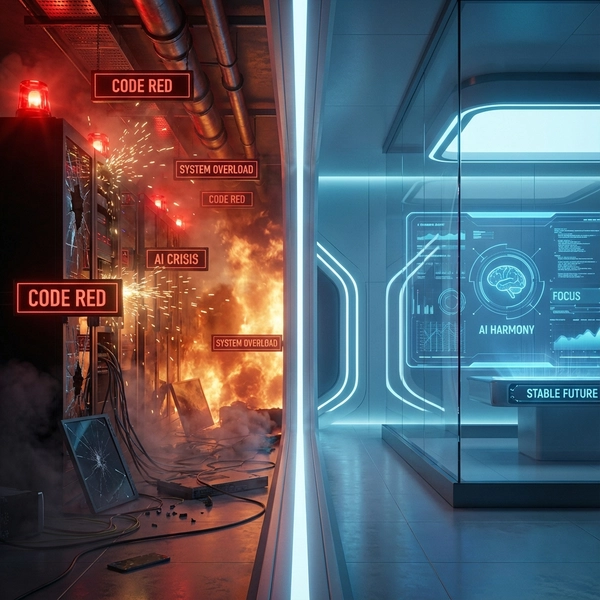
If the reputable “Code Red” rumors are true, OpenAI knows this better than anyone. They aren’t fighting for market share anymore; for the first time in three years, they are fighting for survival as the apex predator of the AI ecosystem.
🦋 Discussion on Bluesky
Discuss on Bluesky