
The Hook: The 10-Mile Barrier
The solution to the energy crisis isn’t in the sky; it’s under our feet. The Earth’s core is a nuclear reactor that has been burning for 4.5 billion years. Just 0.1% of the heat contained in the Earth could power humanity for 2 million years.
So why aren’t we using it?
Because we can’t get to it. Traditional mechanical drill bits—diamond-tipped claws that grind rock—fail at the “Deep Geothermal” barrier. Once you go deeper than 5-10 kilometers (3-6 miles), the physics of drilling fundamentally breaks down due to two factors:
- The Pressure Wall: The rock becomes harder and denser (Basement Rock), wearing out bits every few hours. Tripping the drill string (pulling it out to replace the bit) from 5 miles down takes days, destroying the economics of the project.
- The Heat Wall: The electronics, sensors, and steering mechanisms in the drill string fry at roughly 200°C. Deep geothermal requires we go to 500°C.
We have reached the physical limit of grinding the Earth. To go deeper, we need to stop grinding and start vaporizing.
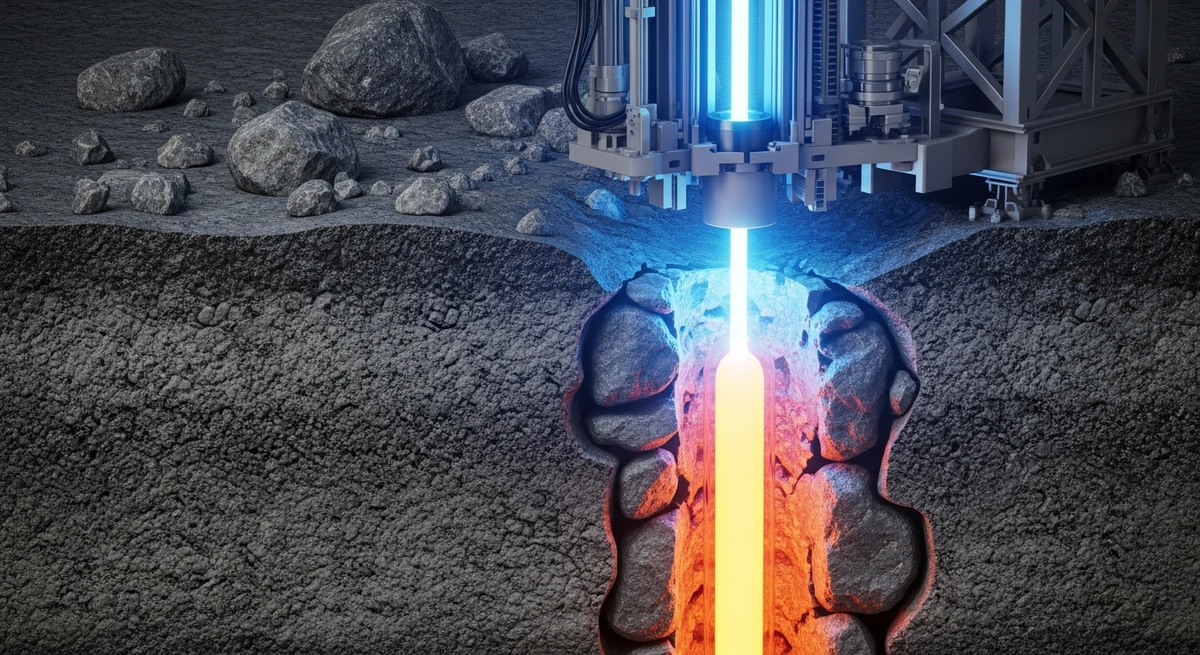
Enter Quaise Energy, an MIT spin-out that is adapting technology from nuclear fusion reactors to melt a hole 20 kilometers (12 miles) straight down.
The Physics Deep Dive: The Gyrotron Tube
The heart of this technology is the Gyrotron. It sounds sci-fi, but it is a piece of hardware that has existed for decades, primarily used to heat plasma in Fusion Tokamaks (like ITER) to millions of degrees. Quaise asks: “If it can heat plasma, why can’t it melt granite?”
Understanding Cyclotron Resonance
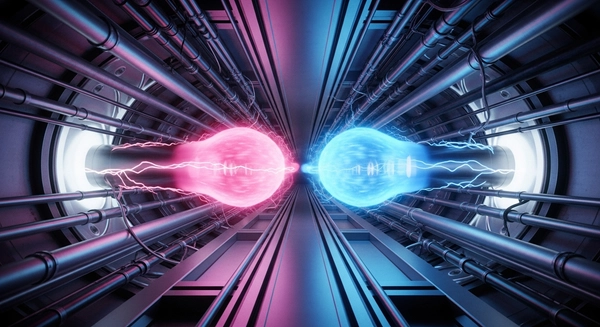
A Gyrotron is a high-power vacuum tube—a Cyclotron Resonance Maser—that generates millimeter waves (frequencies between 30 and 300 GHz). Here is the step-by-step physics:
- Electron Injection: A Magnetron Injection Gun (MIG) shoots a hollow beam of electrons into a vacuum chamber at near-relativistic speeds.
- Magnetic Compression: A massive superconducting magnet (creating a field of ~5-7 Tesla) squeezes these electrons. As they enter the magnetic field, the Lorentz force causes them to spin in tight spirals (cyclotron motion) around the magnetic field lines.
- The Interaction Cavity: This is where the magic happens. The spinning electrons pass through a resonant cavity. By carefully matching the magnetic field strength to the frequency of the cavity, the kinetic energy of the spinning electrons is converted into electromagnetic radiation.
- Coherent Output: The result is a coherent beam of millimeter waves with immense power density—up to 1 Megawatt of continuous power.
Imagine a microwave oven (2.4 GHz) but 1,000 times more powerful, 100 times higher frequency, and focused into a coherent beam that can travel for miles.
Vaporization Physics: Dielectric Heating vs. Ablation
When this beam hits rock, it doesn’t just “heat” it; it transitions it through states of matter violently.
- Dielectric Heating: The electromagnetic field causes the polarized molecules in the rock (silica, quartz) to vibrate millions of times per second. This internal friction generates instant, intense heat.
- Ablation: The rock temperature shoots past its melting point (~1,200°C) to its vaporization point. The rock literally turns into gas and plasma.
- Spallation: At the leading edge of the beam, the thermal shock is so rapid that the rock face fractures and flakes off before it even fully melts. This “spallation” phase actually increases drilling speed because you aren’t melting everything—you are popping the rock apart.
The “Glass” Borehole (Vitrification)
Conventional drilling requires a steel casing and cement to stop the hole from collapsing and to prevent groundwater contamination. This casing is expensive and difficult to deploy at 20km depths.
The Gyrotron solves this with physics. As the beam melts its way down, the “edges” of the beam (the Gaussian tail) melt the surrounding rock wall. As the drill passes, this molten rock cools and solidifies into Obsidian (Vitrified Rock). The drill prints its own casing made of glass. This vitrified wall is pressure-resistant, completely impermeable, and requires no steel or cement. It solves the borehole stability problem automatically.
The Goal: Supercritical Water (The “Holy Grail”)
Why go 20 kilometers deep? To reach Supercritical Water.
At the surface, water boils at 100°C. But deep underground, under immense pressure (22 MPa) and heat (374°C+), water enters a “Supercritical Phase.” It is no longer liquid or gas; it is a ghost fluid that moves with the low viscosity of a gas but dissolves minerals and carries heat with the density of a liquid.
In thermodynamic terms, the Specific Enthalpy (energy content) of supercritical water is massive.
- Viscosity: It flows through rock cracks easily (low friction).
- Density: It is dense enough to spin a turbine blade efficiently.
- Energy Density: A geothermal well tapping into supercritical water has 10 times the energy density of a conventional steam well.
A conventional geothermal well generates ~5 MW of power. A Supercritical well generates ~50 MW. This defines the economics: You need 10x fewer wells to generate the same amount of electricity.
The Engineering Challenge: Why It Is Hard
If the physics is sound, why haven’t we done it? Because engineering a beam to travel 20km is a nightmare.
- Beam Wiggle (Mode Conversion): You cannot just shoot a laser beam down a 20km hole; it will hit the walls and lose power. The millimeter waves must be guided down a corrugated waveguide—a specialized pipe. If the pipe bends or warps even slightly (due to thermal expansion), the “mode” of the wave changes, and it loses efficiency or melts the pipe.
- Ash Removal: You are turning tons of rock into gas and dust (ash). You need to pump a purge gas (Nitrogen or Argon) down the hole at high pressure to lift that ash out. If the ash settles, it blocks the beam, and drilling stops.
- Cooling: The gyrotron itself is on the surface (safe), but the waveguide goes down into the hellish 500°C pit. Keeping that waveguide from melting requires advanced materials and active cooling.
Zanskar vs. Quaise: The Two Paths
We recently covered Zanskar, who uses AI to find hidden geothermal reservoirs. It is crucial to understand the difference.
| Feature | Zanskar | Quaise Energy |
|---|---|---|
| Approach | AI Software | Physics Hardware |
| Problem Solved | ”Where do we drill?" | "How do we drill?” |
| Target Depth | Shallow (2-5 km) | Ultra-Deep (10-20 km) |
| Resource | Natural Hot Springs (Hydrothermal) | Dry Hot Rock (Anywhere) |
Zanskar is optimizing the game we play today (finding the needle in the haystack). Quaise is rewriting the rules of the game entirely (burning the haystack to make the needle).
Contextual History: From Soviet Labs to MIT
The Gyrotron isn’t new. It was invented in the Soviet Union in the 1960s during the height of the Cold War arms race. For 50 years, it was a niche tool for physics experiments, mostly used to heat plasma in Fusion reactors.
In 2008, Paul Woskov at MIT’s Plasma Science and Fusion Center had the crazy idea: “If this beam can heat plasma to millions of degrees, surely it can melt a rock.” He spent a decade proving the physics, demonstrating that millimeter waves could indeed vaporize basalt and granite effectively. In 2018, Quaise was founded to commercialize it. In 2024, they demonstrated the ability to drill a hole at a 100:1 depth-to-width ratio, validating the beam stability physics.
Forward-Looking Analysis: The “Repowering” Strategy
The genius of Quaise’s business model isn’t just drilling; it’s Infrastructure.
Building a new power plant is hard. You need land permits, grid connections, and transmission lines. This can take 10 years. Quaise plans to go to existing Coal Power Plants that are being shut down.
- The Asset: The grid connection is already there. The steam turbine is massive (Gigawatt scale) and ready to spin. The workforce is already there.
- The Retrofit: They simply drill a hole in the parking lot of the coal plant, replace the dirty coal boiler with a heat exchanger from the Earth’s core, and spin the existing turbine.
- The Economics: This dramatically lowers the LCOE (Levelized Cost of Electricity) because 50% of the CAPEX (the plant itself) is already paid for.
By 2030, we might see the first “Repowered” coal plant running on zero-carbon steam from 12 miles down. The Fire of the Earth is waiting; now we finally have the match to light it.
🦋 Discussion on Bluesky
Discuss on Bluesky