
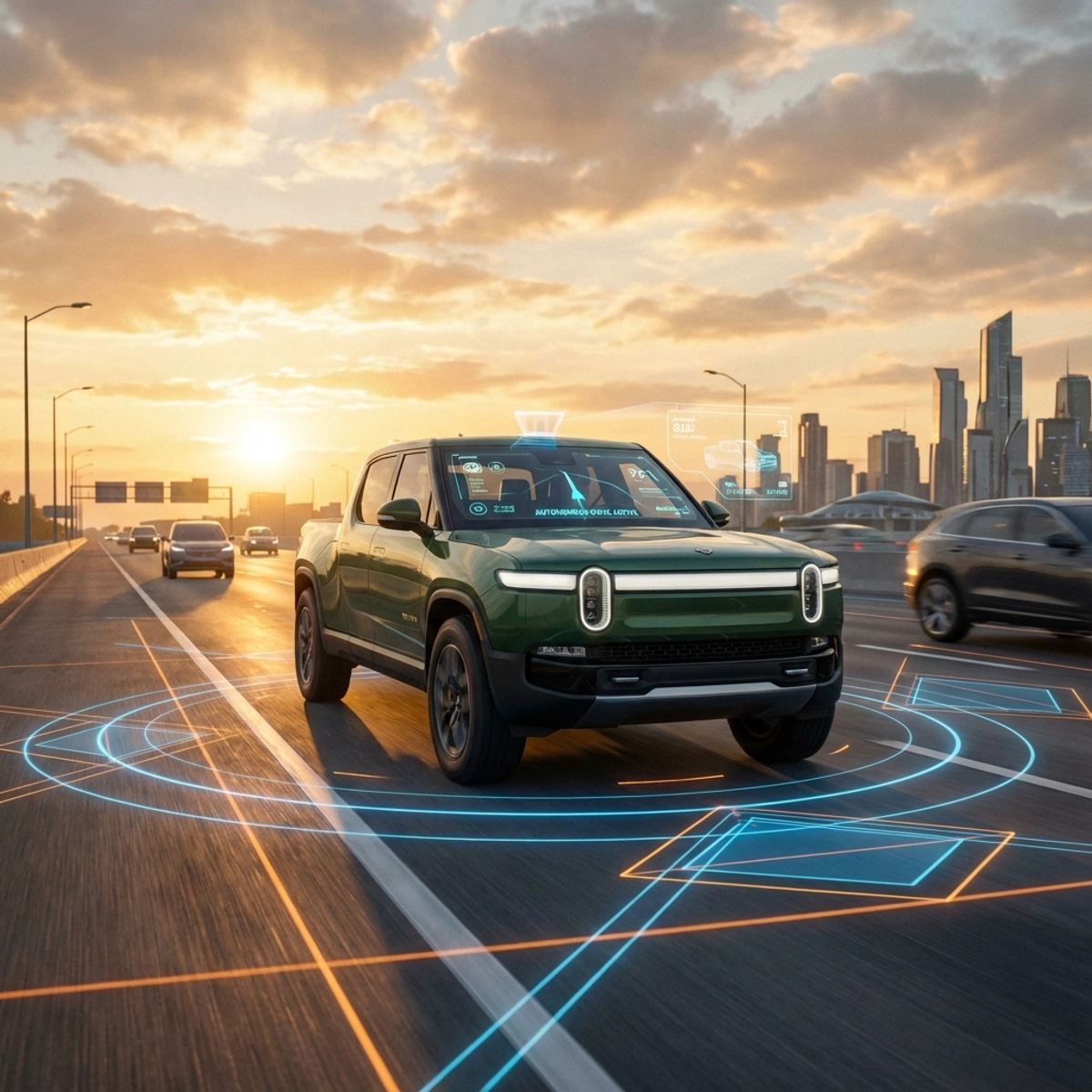
While Tesla’s Full Self-Driving (FSD) grabs all the headlines with its “will they, won’t they” robotaxi promises, Rivian has been quietly executing a massive overhaul of its own driver assistance strategy. With the launch of the second-generation R1T and R1S, Rivian isn’t just playing catch-up; they are laying the groundwork for a system that could leapfrog current “hands-on” requirements.
Rivian CEO RJ Scaringe has outlined a bold roadmap: Hands-free driving in 2025 and “eyes-free” capability by 2026.
Here is everything you need to know about Rivian’s autonomy ambitions and how they compare to the market leader.
The “Rivian Autonomy Platform”
Rivian doesn’t call it FSD. Currently, it’s known as Rivian Driver+, a standard Level 2 ADAS (Advanced Driver Assistance System) similar to Autopilot. However, the underlying tech in the new Gen 2 vehicles is a different beast entirely.
Rivian has moved everything in-house. The new Rivian Autonomy Platform is built on a scalable architecture designed to support higher levels of autonomy over time.
The Hardware: Multimodal vs. Vision Only
The most significant difference between Rivian’s approach and Tesla’s is the sensor suite. While Tesla has famously removed radar to go “vision-only,” Rivian is doubling down on a multimodal approach.
Gen 2 Hardware Specs:
- 11 High-Res Cameras: 360-degree visibility with 8x more megapixels than the previous generation.
- 5 Radars: Providing depth and speed data that cameras might miss in bad weather or tricky lighting.
- Ultrasonic Sensors: For close-range object detection.
- AI Compute: A new in-house compute platform that is reportedly 10x more powerful than the Gen 1 system.
This multimodal strategy (Cameras + Radar) is generally considered safer and more robust by many industry experts, as it provides redundancy. If a camera is blinded by the sun, the radar can still “see” the car in front of you.
The Roadmap: 2025 and Beyond
Rivian represents a shift from “promising the world today” to a structured, tiered rollout.
2025: Hands-Free Highway Driving
Later this year, Rivian plans to release a software update functionality that allows for hands-free driving on highways.
- What it is: Similar to GM’s Super Cruise or Ford’s BlueCruise. You are on a mapped highway, and you can take your hands off the wheel.
- The Catch: You must keep your eyes on the road. The system monitors your attention.
2026: The “Eyes-Free” Goal
This is the big one. Scaringe has stated the target for 2026 is an “eyes-free” system.
- What it means: This approaches Level 3 autonomy. In specific conditions (likely traffic jams or clear highways), the car takes full responsibility. You could theoretically check your email or watch a movie.
- The Reality Check: This is technically very difficult and legally complex. Mercedes-Benz is currently one of the few with a certified Level 3 system in the US, and it’s very limited (under 40mph on specific freeways). If Rivian pulls this off in 2026 at highway speeds, it would be a monumental achievement.
Comparison: Rivian vs. Tesla FSD
| Feature | Rivian (Gen 2 Roadmap) | Tesla FSD (Current) |
|---|---|---|
| Current State | Hands-on, Eyes-on (Driver+) | Hands-on (mostly), Eyes-on |
| Hardware | Camera + Radar (Multimodal) | Camera Only (Vision) |
| Highway | Hands-Free planned for 2025 | FSD Beta (High capability, but technically supervision required) |
| City Streets | Not yet available | Available (Supervised) |
| Eyes-Free Target | 2026 | ”Next Year” (per Elon, explicitly Robotaxi) |
What About Gen 1 Owners?
This is the tough news. The advanced “hands-free” and “eyes-free” features depend heavily on the Gen 2 hardware suite (new cameras, new compute).
- Gen 1 Vehicles: Will continue to receive updates to Driver+, improving smoothness and reliability, but they likely lack the raw compute power and sensor fidelity for the 2026 “eyes-free” targets.
- Gen 2 Vehicles: If you are buying a Rivian today, you want a Gen 2 (2025 model year and later) if autonomy is a priority for you.
The Verdict
Rivian is taking a “slow is smooth, smooth is fast” approach. By keeping the hardware robust (keeping radar) and setting clear, year-by-year targets, they are building trust. They aren’t trying to make your car drive itself in a chaotic city center yet; they are focused on mastering the highway commute first.
If Rivian hits the 2025 “hands-free” target, they instantly reach parity with Ford and GM. If they hit the 2026 “eyes-free” target, they become a true leader in consumer autonomous driving.
🦋 Discussion on Bluesky
Discuss on Bluesky