

Tesla started rolling out version 15 of Full Self-Driving (FSD) on November 21, 2026, and unless you drive a redesigned Model Y, your car probably isn’t getting it yet. Hours before, Elon Musk gave a month for the bigger rollout, without saying which cars it covers: “FSD V15 goes to wide release next month.”
The change you can see is a new view on the car’s screen. Tesla calls it Reality View, and it shows your car and the street around it from above, as a live picture instead of the hard-coded 3D models FSD drew before. The build is still labeled FSD (Supervised), and Tesla’s support page says those features don’t “replace you as the driver.”
Which cars get FSD v15?
Tesla’s launch posts name no car models and no computer. Electrek notes that Tesla “has previously told investors that its AI4 (HW4) computer is enough to run v15.” HW3 and HW4 are versions of the car’s FSD computer, and the HW3 or HW4 guide shows how to tell which one you have. The rest comes from Tesla software trackers and Tesla news sites, read on November 22.
| Your car | v15 as of November 22, 2026 | FSD it can run instead |
|---|---|---|
| Redesigned Model Y with HW4, in the US or Canada | Rolling out in small numbers | v14.3.13 |
| Other HW4 cars in North America | Not reported yet | v14.3.13 |
| HW3 cars in North America | Not coming until “a hardware upgrade is available,” per Not a Tesla App | v14.3 Lite |
| Cars in Europe | Not there, per TeslAnt | v14.2.2.7, called Tesla Assisted Driving, where approved, per TeslAnt, which doesn’t split it by computer |
The first release is FSD (Supervised) v15.0.1, inside update 2026.38.6.11. Teslascope, which counts installs on the cars it follows, had logged 11, all on Model Ys with HW4, and those with a known country were in the United States. It doesn’t separate old Model Ys from new ones. Not a Tesla App does: it says the build “currently appears limited to the redesigned Model Y, which is late 2025 or 2026+ models in the U.S. or Canada.” TeslAnt adds that Not a Tesla App had not seen it on a Model 3, Model S, Model X, Cybertruck or Model Y L.
Reports differ on who is in that first group. Teslarati wrote on November 21 that the first builds were going to members of Tesla’s Early Access Program, a group of owners who get new versions first. Not a Tesla App wrote a day later that it is “going out beyond just early access testers.”
Will HW3 cars get FSD v15?
Not a Tesla App says no. It wrote in October that Tesla “has confirmed that HW3 won’t support unsupervised FSD or the upcoming FSD v15 update.” Its report on the rollout also rules out a cut-down version: “HW3 vehicles will not receive FSD v15 or v15 lite and v14 Lite is the expected end of the road for those vehicles until a hardware upgrade is available.” Tesla’s launch posts don’t mention HW3 either way.
HW3 cars are on a separate branch. v14.3 Lite began reaching them in October. Update 2026.44.1, which started rolling out this week, changes where new subscribers begin: Not a Tesla App says those in North America now get v14.3 Lite right away, instead of starting on v12.6. The HW3 owner’s guide covers the computer upgrade Tesla has promised to owners who bought FSD, which has no date.
When is the wide release?
Musk gave a month and no day. He posted the “next month” line late on November 20, Pacific time, which was already November 21 on the East Coast. Asked whether V15 would come with a holiday update, he replied “Yeah.” That points to December, but neither post says which cars or countries “wide” covers.
What does Reality View show?
Tesla’s notes describe a “real-time generative driving visualization that continuously streams a view from an arbitrary virtual camera situated above your vehicle.” You can run it full screen, switch to the map, or split the two, and upcoming turns appear in the picture itself. Musk says “You can tap any point on the reality revisualizer to make your car go there.” Tesla’s notes say only that you can “see and control what FSD is planning to do.”
The early videos are striking. Nic Cruz Patane, who posted the clip below, called it “absolutely INSANE.” Sawyer Merritt, after a 25-minute night drive, wrote that it is “even more mind-blowing in person than how it appears online.” Both accounts follow Tesla closely, and these are first looks, not tests.
Is it a camera feed? No, it’s drawn by AI
The word to notice in Tesla’s notes is “generative.” Musk explained on November 22 that the picture comes from its own artificial intelligence (AI) model. The car’s vision system feeds “the 3B encoder model that produces the driving actions,” and a second branch of it feeds “a separate ~1B diffusion model” that draws the screen. By his description, that model starts each time from its own previous picture “with added noise” and cleans it up into the current one.
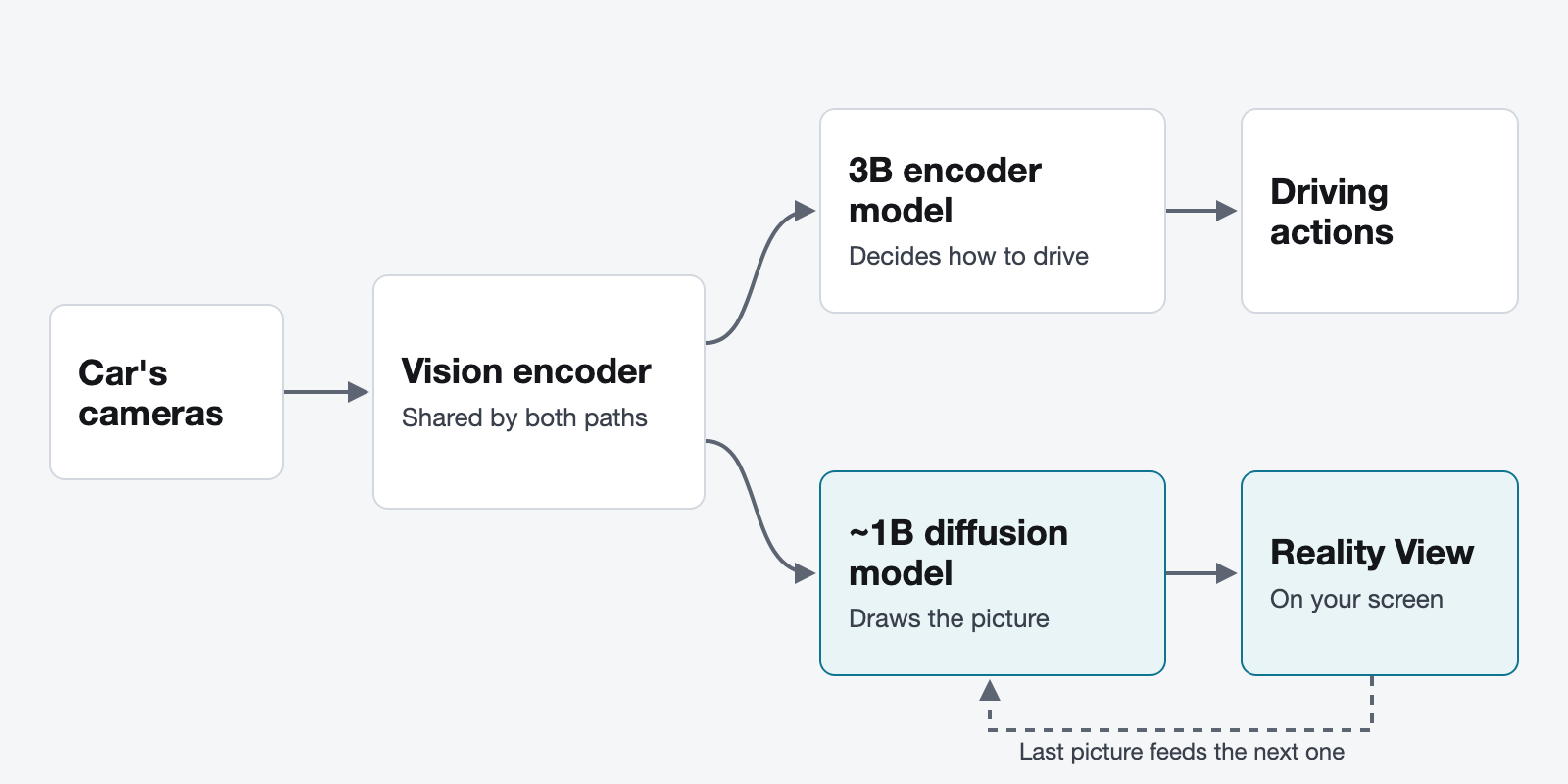
So the picture and the driving share the same eyes, but the picture is a drawing of what the car sees. Not a Tesla App describes the method differently, saying camera pixels are mapped onto a 3D stage, and that “Generative AI then fills in any gaps.” Musk also says it lags: “the latency is a bit high due to compute constraints,” though he says Tesla has ways to cut “roughly 35%” of it.
Keep that in mind when you back up. One X user has already posted that “backup cameras are a thing of the past.” Nothing in the release notes says Reality View replaces your mirrors or rearview camera. Treat it as a drawing of what the car sees and plans, and check the real cameras before you reverse.
What else is new in v15?
These are Tesla’s descriptions, from its posts and release notes.
- Speed cameras: FSD can slow down when it detects one. Press the accelerator or raise your speed profile to cancel. Cancel twice at the same camera and the car stops slowing there; undo that under “Controls > Service > Manage Saved Locations.”
- Bike racks: Bike Rack Mode lets you use FSD with a rack or similar hitch accessory. The car pulls over near your destination and “does not reverse,” and Autopark, Summon and backup warnings are off.
- Routes: the start and end of a trip now use a model trained on the fleet’s route preferences. Tesla says later v15 releases “will expand this to the entire route.”
- Parking: spot choice uses your own parking history, and the map shows several options.
- Road hazards: Tesla lists better detection of signs, small animals, debris, chains and potholes, and avoidance of deep standing water. TeslAnt points out that the pothole line promises detection, “not that the car steers around them.”
- Driver monitoring: camera-based monitoring is available more often with hats and sunglasses, and Tesla is “decreasing strictness in higher speed driver profiles.” Electrek points out that this comes “at a time when sleeping drivers on FSD keep making headlines.”
What does “25x” mean?
It is Tesla’s own number, and Tesla and its staff have worded it more than one way. The launch post says “25x better handling of safety critical cases.” The release notes say an upgraded vision encoder is “improving the critical intervention rate by 25x.” They don’t define a critical intervention. Phil Duan, whose X profile says he leads self-driving at Tesla, went further: “v15 is 25x safer than v14 across the fleet.” None of the three gives the rate before or after.
Electrek tried to fill in the blank from its own earlier data, which suggested v14 could go “a couple thousand miles” between critical interventions. A 25x gain would put v15 “around 50,000 miles,” by its estimate. It also warned that “a 25x multiplier without the underlying number is hard to check.”
Is FSD v15 unsupervised?
No. The release notes call it FSD (Supervised) v15.0.1, and Tesla’s support page, read November 22, says FSD (Supervised) “is intended to be used only with a fully attentive driver.” That is well short of the sales pitch. In April, Musk wrote that V15 “will far exceed human levels of safety, even in completely unsupervised and complex situations.” After launch he said it “drives better than human intelligence.”
Tesla’s estimate for going further is 2027. On the third-quarter earnings call in October, AI chief Ashok Elluswamy said the software Tesla’s Cybercab and Model Y robotaxis run would come to customers as part of V15, and then: “We suspect somewhere around Q2 next year is when we can turn on some of the first customer vehicles to be part of the Robotaxi fleet.” He said those customer Model Ys would need to be part of Tesla’s geofences and fleet management, so that is about joining the Robotaxi service, not driving unsupervised anywhere.
Should you start FSD now or wait?
If v15 is the reason you want FSD, wait until owners with your model and computer report getting it. FSD costs $99 a month in the US, per Tesla’s support page on November 22, and Tesla does not refund subscriptions, though you can cancel and keep access until the billing period ends. Subscribing early may not put you on v15 either. Not a Tesla App says Tesla tends to keep newer FSD builds on their own track, and that new subscribers on regular updates used to start on older versions.
The free month is worth timing even more carefully. Through a link from an owner who has FSD, Tesla’s referral program gives eligible owners a one-month trial. Among other rules, Tesla’s support page rules out anyone who has had a referral or delivery trial, or paid for a subscription, in the past 12 months, and anyone who bought FSD outright. Use it before your car can get v15 and you spend it on v14.
Waiting has a cost too. The referral offer could change or your friend’s link could run out before v15 reaches your car, and the FSD free trial guide has the full rules and limits. On an HW3 car there is no v15 to wait for, if Not a Tesla App is right. The Autopilot vs FSD guide covers what you get without paying.
Sources (23)
- x.com Tesla on X: FSD v15 now starting to roll out (November 21, 2026)
- x.com Tesla Super Intelligence on X: Reality View, Speed Camera Slowdown and Bike Rack Mode notes (November 21, 2026)
- notateslaapp.com Update 2026.38.6.11 (FSD 15) release notes
- notateslaapp.com Tesla FSD v15 Rolls Out With Incredible New Reality View
- notateslaapp.com Tesla Update 2026.44 Includes FSD v14.3 and v14.3 Lite
- notateslaapp.com Not a Tesla App (Oct 14, 2026): Tesla Rolls Out FSD V14 Lite to Legacy Model S/X for First Time
- teslascope.com software 2026.38.6.11 installs (read November 22, 2026)
- teslarati.com Tesla Full Self-Driving v15 rollout begins
- electrek.co Tesla launches FSD v15, targets its biggest weaknesses
- teslant.com Tesla Starts Rolling Out FSD v15
- x.com Elon Musk on X: FSD V15 goes to wide release next month
- x.com Elon Musk on X: reply about V15 and the holiday update
- x.com Elon Musk on X: V15 re-renders reality, tap any point (November 21, 2026)
- x.com Elon Musk on X: how Reality View is generated (November 22, 2026)
- x.com Elon Musk on X: V15 drives better than human intelligence (November 2026)
- x.com Elon Musk on X: V15 will far exceed human levels of safety (April 2026)
- x.com Phil Duan on X: v15 is 25x safer than v14 (November 21, 2026)
- x.com Sawyer Merritt on X: 25-minute drive on FSD V15 (November 21, 2026)
- x.com Nic Cruz Patane on X: Reality View downtown (November 21, 2026)
- x.com Roger Kappler on X: FSD V15 and backup cameras (November 21, 2026)
- evwire.com Tesla Q3 2026 earnings call full transcript
- tesla.com Tesla Support: Full Self-Driving (Supervised) (read November 22, 2026)
- tesla.com Tesla Support: FSD (Supervised) Referral Program (read November 22, 2026)


Discussion on Bluesky
Discuss on Bluesky