


You don’t need to become a coffee hobbyist to buy a good small espresso machine. You need to know three things: what it costs, whether it fits your counter, and how much work it expects from you. That’s what this guide covers, in that order.
Quick answers first. If you want cheap and easy espresso from regular pre-ground coffee, get the Casabrews CM5418 at $125.99. If you want one machine that can do easy mode now and fancier coffee later, get the Breville Bambino at $299.95. And if you came here searching for a Ninja: the cheapest Ninja with a real espresso portafilter is $449.99. Details on all of them below.
Every spec and price here was read on the manufacturer’s own page or manual, as of early September 2026; every price was read on September 3. Prices move often. The Amazon links are affiliate links and the site may earn a commission; every link was checked against the exact model number.
The seven machines at a glance
| Machine | Price | Who it’s for |
|---|---|---|
| Wacaco Nanopresso | $69.90 | Travel: no cord, you pump it by hand |
| Casabrews CM5418 | $125.99 | Cheap, easy shots from pre-ground coffee |
| Breville Bambino | $299.95 | Most people: easy mode now, more control later |
| Flair 49 PRO | $359.00 | People who enjoy doing it all by hand |
| Ninja Luxe Café Mini | $449.99 | Push-button café drinks |
| Gaggia Classic Pro E24 | $549.00 | Upgraders who want a machine to grow into |
| Smeg ECF02 | $600.00 | Kitchens where looks come first |
Two words you’ll see a lot in this guide, in plain English. The portafilter is the metal cup with a handle that you fill with coffee and lock into the machine; commercial-size ones match what coffee shops use, so spare parts are easy to find. The basket is the small metal filter that sits inside the portafilter and holds the coffee. Baskets come in two types, and that difference matters more than any number on the box. It’s explained right after the picks.
What about a Ninja espresso machine?
A lot of people search for Ninja by name, so this is the straight answer, read from SharkNinja’s own store on September 3, 2026.
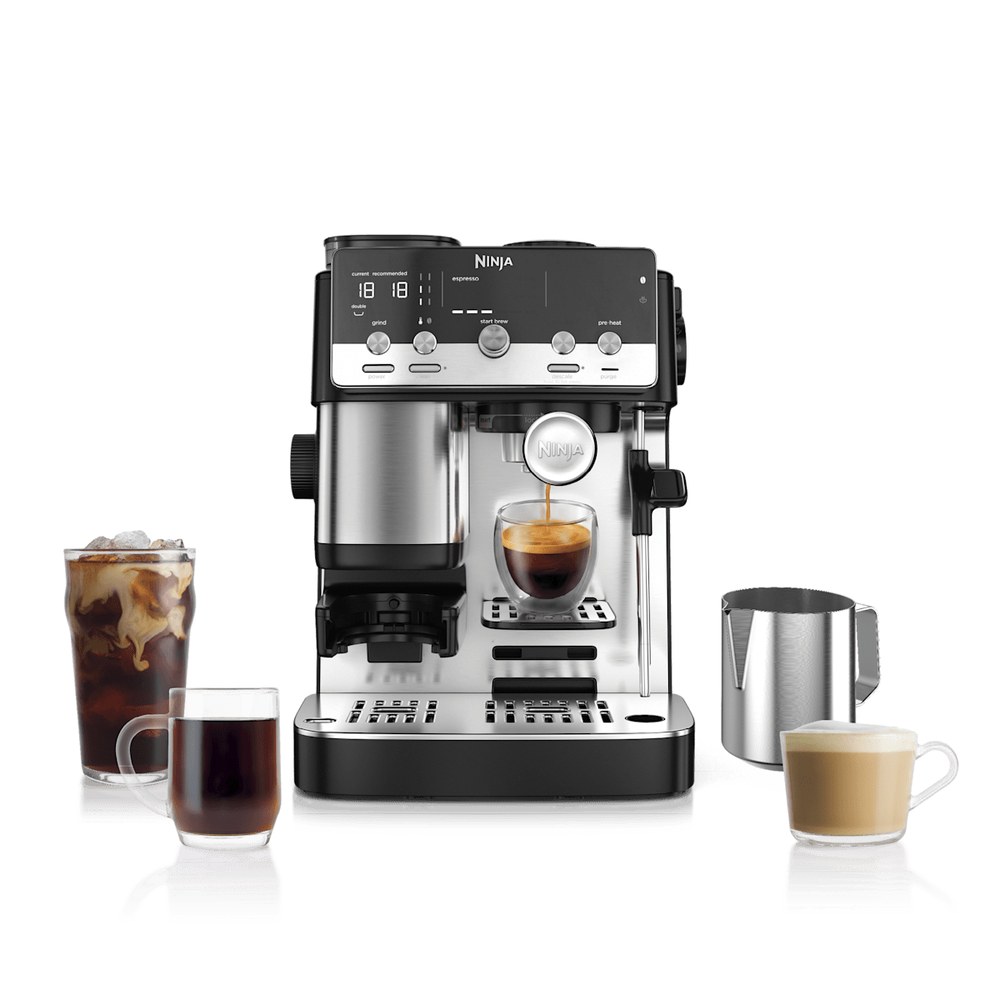
There is no Ninja espresso machine under $200. The cheapest espresso machine Ninja sells is the Barista System (CFN601), a pods-or-grounds machine with no portafilter, listed at $249.99 on September 3, 2026, marked down from $279.99. The cheapest Ninja with a real portafilter is the Luxe Café Mini (ES301) at $449.99, which SharkNinja pitches as “Best for crafting café-inspired drinks in compact spaces.” There is now a sibling, the Luxe Café Mini Plus AutoFroth (ES351) at $499.99, which adds a hands-free milk-frothing system to the same compact body.
The Ninja pitch is simple: the machine handles the hard parts for you. The line’s stated feature is “Barista Assist Technology auto-calibrates for the perfect brew.” If what you want is consistent café drinks without fiddling with settings, that is a real feature, not a gimmick. You pay for it: at $449.99, the Mini costs about $150 more than the Bambino.
One size note: the Luxe Café Mini measures 10.24 by 12.17 by 13.43 inches, which makes it wider than the Breville Bambino. “Mini” means small for a Ninja, not small, period.
If the push-button approach sounds like you, the Mini is the one to look at (check price on Amazon).
The picks, cheapest first
Wacaco Nanopresso, $69.90: espresso anywhere
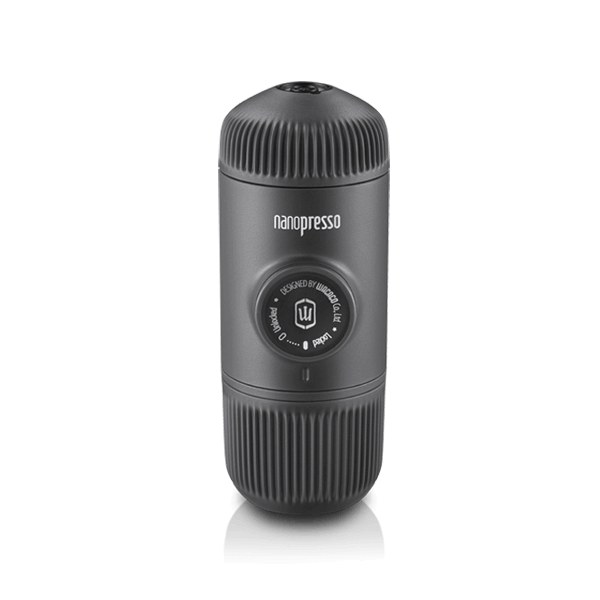
No cord, no electric pump, no counter needed. You add hot water and coffee, then press a knob with your thumb. Wacaco describes “a patented pumping system capable of reaching up to 18 bars of pressure,” powered entirely by your hand. Wacaco’s own store had it at $64.90 against a $69.90 list on September 3, 2026. It ships with an “easy crema pressurized portafilter,” which means it is set up to make decent, forgiving shots without any skill.
Buy it if you want espresso on a campsite, in a hotel room, or at a desk, and you’re fine with your arm doing the work.
Casabrews CM5418, $125.99: cheap and easy, on purpose
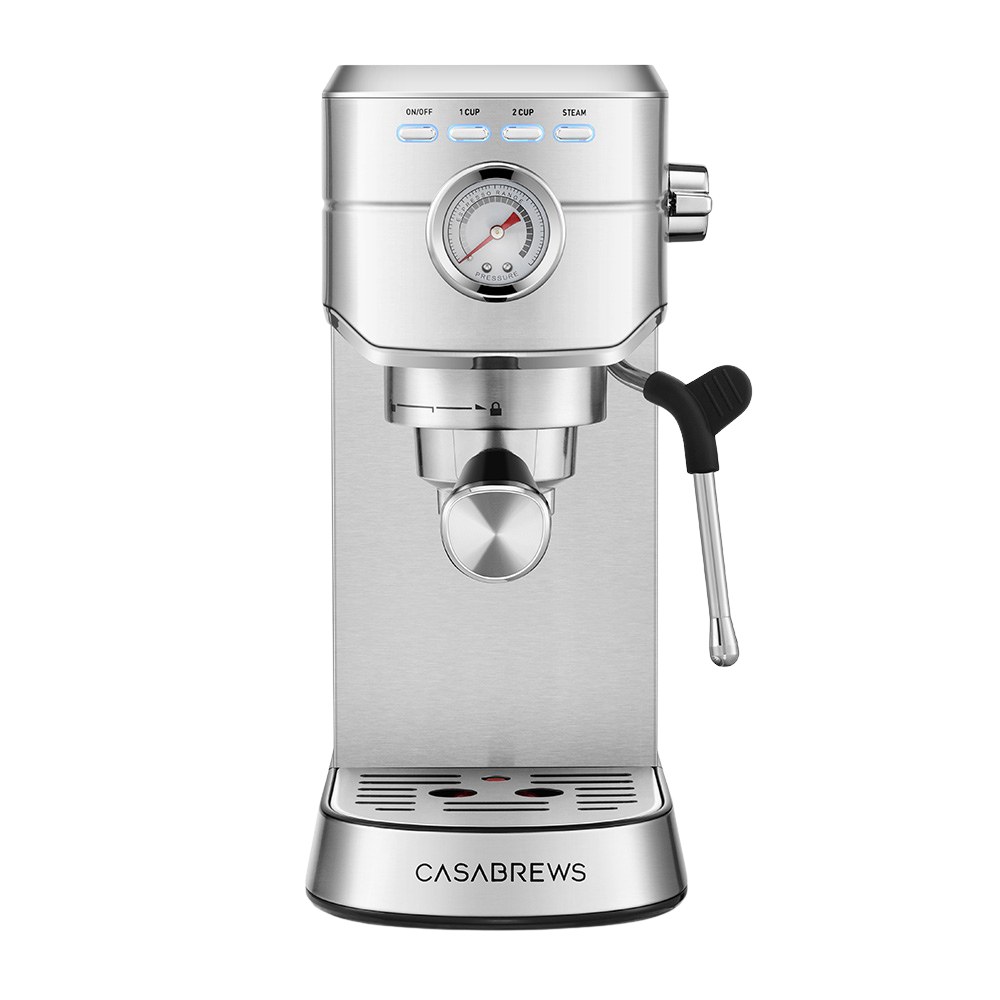
This is the budget pick, and it is honest about what it is. It ships with a “51mm aluminum portafilter and two dual-wall filters to support stable, beginner-friendly extraction,” in Casabrews’ own words. Plain English: the baskets do the hard work for you, so shots come out consistent even with cheap pre-ground coffee. No grinder needed, nothing to dial in. It is also genuinely small at 5.47 inches wide, with a 34 oz water tank. Casabrews’ own price for the silver model was $125.99 on September 3, 2026, down from the $159.99 it listed in August; the colored versions cost more.
The one trade-off: this machine only does easy mode, because both included baskets are the dual-wall type and no single-wall option ships with it. For most people buying at this price, that is exactly right.
Buy it if you want good, consistent espresso-style coffee from the bag of pre-ground in your pantry, with zero fuss.
Breville Bambino (BES450), $299.95: the one for most people
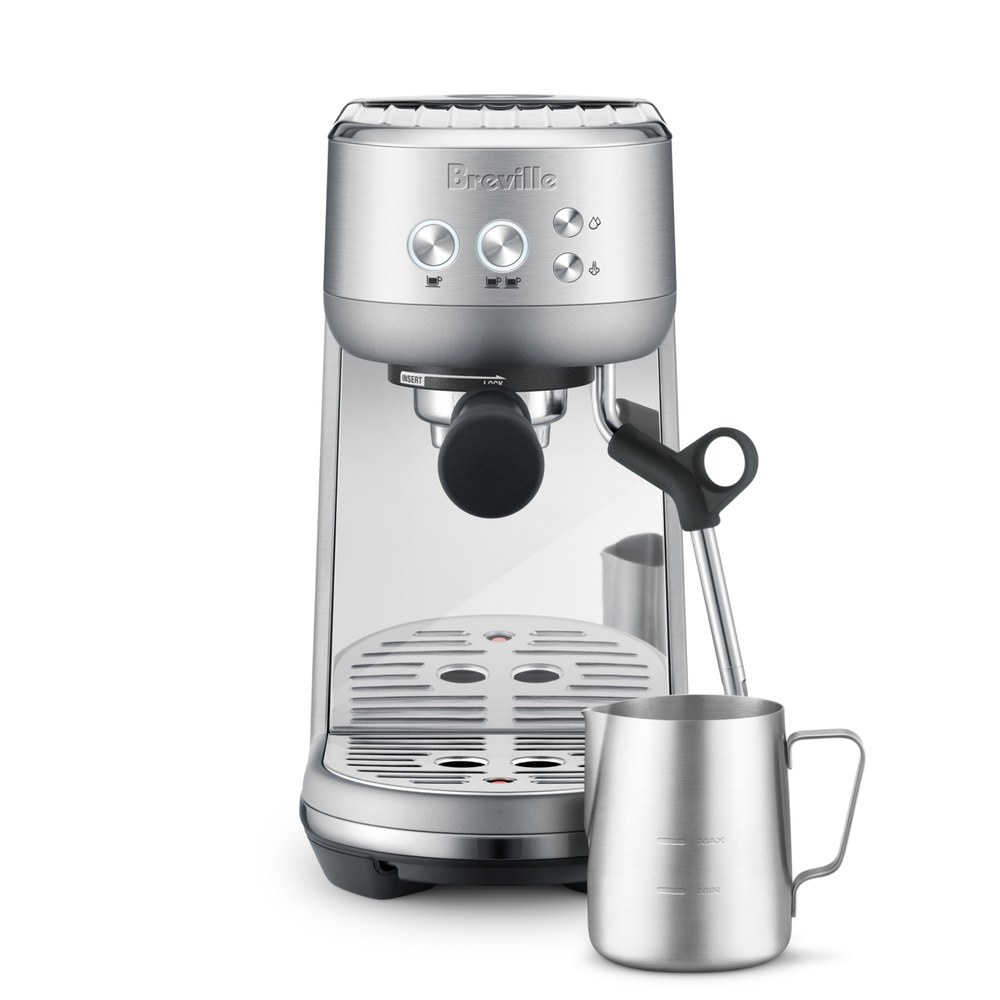
The Bambino’s trick is that it doesn’t make you choose. It ships with both kinds of filter basket: the forgiving dual-wall type for pre-ground coffee, and the single-wall type for freshly ground beans. The single-wall basket comes fitted from the factory, but swapping in the dual-wall one takes seconds. So it can be an easy machine now and a hobby machine later, without buying anything new. It has a 54 mm portafilter and a 47 fl.oz tank.
Know this going in: if you use the single-wall basket, you also need a burr grinder, because that basket only works with fresh, finely ground beans. More on that below, including what a grinder costs.
Buy it if you’re not sure how far you’ll take this. It does easy mode and serious mode, and it costs half of what some machines here charge for easy mode only.
Flair 49 PRO, $359.00: all manual, by choice
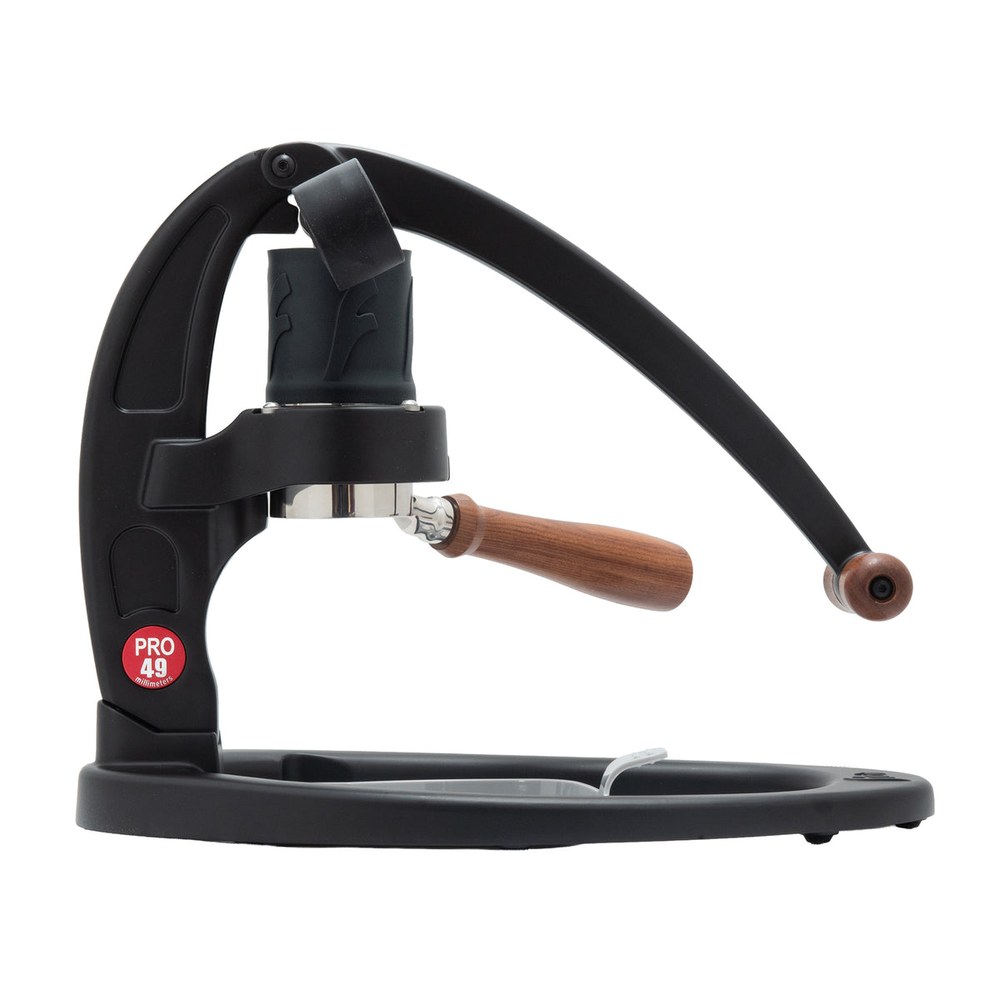
A lever machine: no electricity in the brewing at all. You pull an arm, and that pressure makes the shot, read off a gauge as you go. It ships with both a pressurized basket for beginners and a bottomless one to graduate to. This is the opposite of the Ninja’s push-button pitch: the entire point is doing it yourself.
Buy it if making the coffee is part of the fun for you. If you just want coffee to appear, buy something else on this list.
Gaggia Classic Pro E24, $549.00: the one to grow into
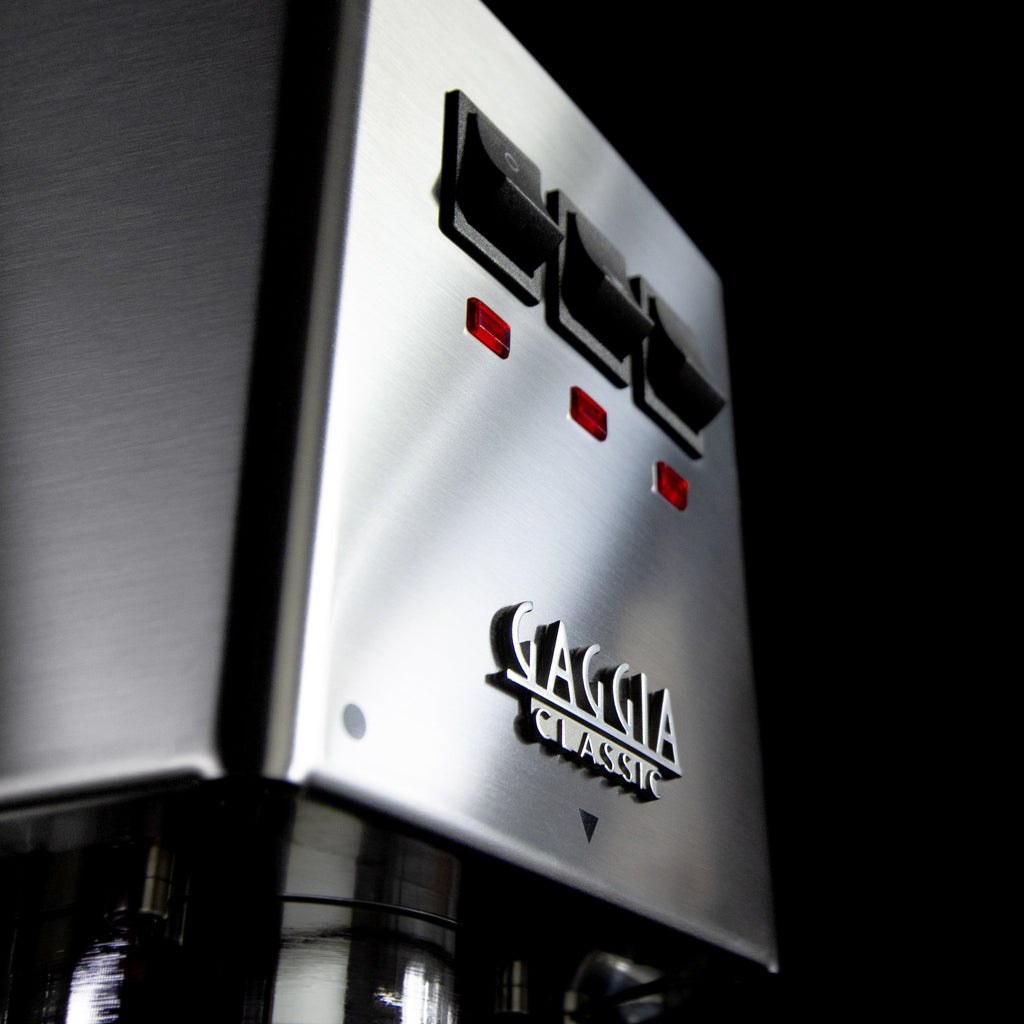
The step-up pick. It uses a 58 mm stainless steel portafilter, the same size as commercial café machines, so replacement baskets and tampers are cheap and everywhere. It ships with both basket types, and Gaggia is refreshingly clear about the intended path: the easy “Crema perfetta” filter “is already installed on the filter holder,” and Gaggia’s “advice is to start with the ‘crema perfetta’ filter and then, once you have acquired manual skills and experience, move on to traditional ones.” Start easy, upgrade when you feel like it.
Buy it if you want a machine you won’t outgrow. Pair it with a grinder when you switch to the traditional baskets.
Smeg ECF02, $600.00: the pretty one (read this before buying)
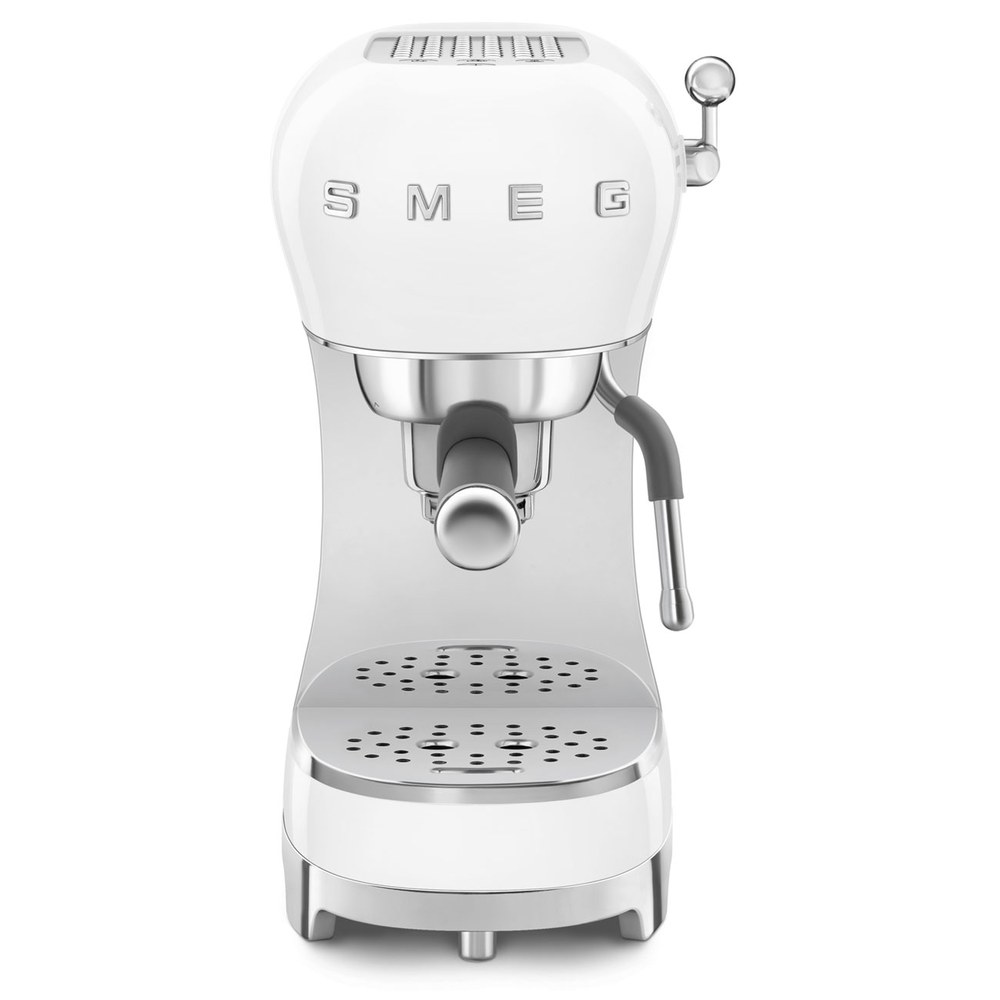
It is a beautiful object, and that is a legitimate reason to buy a kitchen appliance. But know what’s in the box. Smeg’s manual says: “This machine includes 3 filters; two pressurised for ground coffee and one for paper coffee pods.” That means the $600 Smeg is an easy-mode-only machine, the same approach as the $125.99 Casabrews: there is no single-wall basket in the box, and Smeg doesn’t list one to add. The $299.95 Bambino includes both types.
One availability note: Smeg’s US site showed the white ECF02 at $600 but out of stock on September 3, 2026.
Buy it if the design is genuinely why you’re buying, and you’re happy paying a premium for easy mode in a prettier shell.
The numbers on the box, in plain English
Espresso machine boxes shout pressure numbers: 15 bar, 20 bar. This is what that number is: a rating for the pump part inside, not a measure of your coffee. Breville says it plainly in its own Bambino sales copy, describing “a high pressure (9 bar) extraction process delivered via our 15 bar Italian pump.” The pump is rated 15. The coffee gets 9. A bigger number on the box does not mean better coffee.
Gaggia is one of the only makers that prints both numbers, in two spec rows: “Pump” is listed as “15 Bar Italian-made Ulka Pump,” and “OPV Calibration” as “9 Bar.” The OPV is the valve that limits what the coffee sees. Most brands never publish it. So don’t shop by bar count. Shop by price, size, and the basket question below.
The real question: pre-ground or fresh-ground?
This is the choice that changes your coffee, and it comes down to which filter basket the machine uses.
Dual-wall (also called “pressurized”) baskets are the easy mode. In Breville’s words, they “regulate the pressure and help to optimize the extraction regardless of the grind, dose, tamp pressure or freshness.” Translation: the basket makes the shot consistent even with pre-ground grocery-store coffee. If you don’t want espresso to be a hobby, this is the feature you want, and there’s no shame in it. The Casabrews and the Smeg work this way out of the box.
Single-wall baskets are the control mode. The pressure comes from the packed coffee itself, so they only work with beans ground fine and fresh, which means owning a burr grinder. Breville prices that reality in public: the Bambino Plus costs $499.95 alone, or $649.95 bundled with a Baratza Encore ESP grinder, a $150 difference. If a machine ships single-wall only, add that to its real price.
Breville’s own manual states the rule in two sentences: “Use Single Wall filter baskets if grinding fresh whole coffee beans,” and “Use Dual Wall filter baskets if using pre-ground coffee.” That is the entire decision. Match the basket to the coffee you plan to buy, and ignore anyone who tells you one of those choices doesn’t count as real espresso.
Before you buy anything, check the accessories list for the words “dual wall,” “double wall,” or “pressurized,” and check the manual if the product page doesn’t say. Smeg’s US spec page lists its filters only by cup count; you have to open the manual to learn that the ground-coffee filters are pressurised.
Will it fit your counter?
Three quick checks before you order:
- Leave room for the handle. One guide’s advice worth repeating: “leave 2-3 inches behind the machine for the portafilter handle during operation.”
- Check the height under cabinets. The same guide says to “verify the machine fits with the portafilter locked in place.” You’ll also want room above the machine to lift the water tank out.
- Compact means different things. The Casabrews is 5.47 inches wide; the Ninja Luxe Café Mini measures 10.24 by 12.17 by 13.43 inches overall. Both are sold as compact. Measure your spot.
Here are the published sizes, straight from each maker, for the machines that print them:
| Machine | Size as published by the maker |
|---|---|
| Casabrews CM5418 | 5.47 inches wide |
| Breville Bambino | 11.9 x 6.1 x 13.5 inches, in Breville’s stated “W x D x H” order |
| Ninja Luxe Café Mini | 10.24 x 12.17 x 13.43 inches |
| Gaggia Classic Pro E24 | Height 14.2 in, Width 8 in, Depth 9.5 in |
Notice that only Gaggia labels each measurement on its own row, so there is nothing to misread. Breville publishes one combined string, and you have to trust the header for which number is which. For any machine not in this table, find the size on the maker’s page for your exact model before you order.
Frequently asked questions
What is the best compact espresso machine?
For most people, the Breville Bambino at $299.95: it ships with both kinds of filter basket, the forgiving dual-wall type for pre-ground coffee and the single-wall type for fresh beans, so it can be an easy machine now and a hobby machine later. If you just want cheap, consistent shots from pre-ground coffee, the Casabrews CM5418 at $125.99 is the budget pick, at 5.47 inches wide. Upgraders who want a machine to grow into should look at the Gaggia Classic Pro E24 at $549, with its commercial-size 58 mm portafilter.
What is the cheapest Ninja espresso machine?
There is no Ninja espresso machine under $200. The cheapest espresso machine Ninja sells is the Barista System (CFN601), a pods-or-grounds machine with no portafilter, listed at $249.99 as of September 3, 2026; the cheapest Ninja with a real portafilter is the Luxe Café Mini (ES301) at $449.99. That’s about $150 more than the Breville Bambino, and at 10.24 by 12.17 by 13.43 inches the Mini is wider than the Bambino too.
Does a 15 bar or 20 bar espresso machine make better coffee?
No. The number on the box is a rating for the pump inside, not a measure of your coffee. Breville’s own Bambino copy describes “a high pressure (9 bar) extraction process delivered via our 15 bar Italian pump.” Gaggia prints both numbers in two spec rows, “15 Bar Italian-made Ulka Pump” and “OPV Calibration” at “9 Bar”; the OPV is the valve that limits what the coffee sees. Shop by price, size, and which baskets are included instead.
Can you use pre-ground coffee in an espresso machine?
Yes, if the machine has dual-wall (also called “pressurized”) baskets, which in Breville’s words “regulate the pressure and help to optimize the extraction regardless of the grind, dose, tamp pressure or freshness.” The Casabrews ships with two dual-wall filters and no single-wall option, and Smeg’s manual says the ECF02 includes “two pressurised for ground coffee and one for paper coffee pods.” The Bambino, the Flair 49 PRO, and the Gaggia Classic Pro include both basket types.
Do you need a grinder for an espresso machine?
Only if you use single-wall baskets, where the pressure comes from the packed coffee itself, so they only work with beans ground fine and fresh. Breville’s manual states the rule in two sentences: “Use Single Wall filter baskets if grinding fresh whole coffee beans,” and “Use Dual Wall filter baskets if using pre-ground coffee.” Breville prices the grinder in public: the Bambino Plus costs $499.95 alone, or $649.95 bundled with a Baratza Encore ESP grinder, a $150 difference. If a machine ships single-wall only, add that to its real price.
How much counter space does an espresso machine need?
More than the footprint. One guide’s advice worth repeating: “leave 2-3 inches behind the machine for the portafilter handle during operation,” and “verify the machine fits with the portafilter locked in place” under your cabinets. “Compact” varies a lot: the Casabrews is 5.47 inches wide, the Breville Bambino is 11.9 x 6.1 x 13.5 inches in Breville’s stated “W x D x H” order, and the Ninja Luxe Café Mini measures 10.24 by 12.17 by 13.43 inches. Measure your spot.
The short version
Buy the Casabrews if you want cheap and easy. Buy the Bambino if you want options. Buy the Ninja if you want push-button drinks and the price doesn’t bother you. Ignore the bar number on the box, check which baskets are included, and measure your counter with a couple of inches to spare. That’s the whole game.
And if what you drink is a mug of regular coffee rather than espresso, there’s a separate guide to premium drip coffee makers that covers that side of the counter.
Sources (17)
- breville.com Breville US: the Bambino product page
- breville.com Barista Express instruction book, US BES870XL
- assets.breville.com Breville: Bambino instruction book, US BES450
- assets.breville.com Breville ANZ: Barista Express instruction book, BES875
- breville.com Breville US: espresso machine range
- lexavebrew.com Best Compact Espresso Machines in 2026
- breville.com Pressurized vs non-pressurized portafilter baskets
- gaggia-na.com Gaggia North America: Classic Pro E24 product page
- gaggia-na.com Gaggia North America: Classic GT product page
- smeg.com Smeg US: ECF02 espresso machine
- web.archive.org Smeg: ECF02 user manual (archived PDF)
- flairespresso.com 49 PRO product page
- wacaco.com Nanopresso product page
- flairespresso.com 49 PRO instruction manual
- cdn.shopify.com Gaggia: Classic E24 USA instruction manual
- casabrews.com CM5418 product page
- sharkninja.com Ninja espresso machines category



🦋 Discussion on Bluesky
Discuss on Bluesky