


Apple’s store lists seven iPhones across six tiles as of October 22, 2026: the iPhone 17e from $699, the iPhone 16 from $799, the iPhone 17 from $899, the iPhone Air from $1,099, the iPhone 18 Pro from $1,199 and the 18 Pro Max from $1,299, plus the folding iPhone Duo from $1,999, on pre-order since October 16 and on sale October 23 (the 17 and 16 tiles include a $30 discount for activating with a carrier at checkout; without it they are $929 and $829). There is no standard iPhone 18. Apple’s September 9 iPhone releases cover only the two Pro models and the Duo, so the real choice is a year-old iPhone 17, a new Pro, or the foldable.
For most people the answer is the iPhone 17. It is $929 with 256GB, or $899 if you activate with a carrier at checkout, it is the cheapest iPhone with a 120Hz display, and Tom’s Guide measured its battery at 12 hours 47 minutes. Pay $1,199 for the iPhone 18 Pro if you want a telephoto lens and the new variable-aperture camera; the labs have tested it now, and it ran 16 hours 17 minutes on the same test. Buy the $699 iPhone 17e if the budget is the whole decision. Skip the iPhone 16: it costs at least $100 more than the 17e for an older chip and half the storage.
Every current price here is Apple’s own list price as of October 22, 2026. Apple’s starting prices on the iPhone 17 and iPhone 16 include a $30 discount for connecting to AT&T, T-Mobile or Verizon at checkout; Apple says it “is not available for customers who choose to connect to a carrier later, or who have a prepaid carrier plan.” This guide uses the price without the discount, so subtract $30 from either phone if you will activate at checkout. The phone is unlocked either way: Apple’s buy page says “An iPhone purchased from Apple is unlocked,” unless you finance it through a carrier’s installment plan, in which case it “will be locked to the carrier until paid in full.” Every model here sold in the U.S. is eSIM-only, with no physical SIM tray. Battery times are from Tom’s Guide’s battery test unless another lab is named. The Amazon links are affiliate links and the site may earn a commission.
One warning before the list. Apple confirmed on October 2 that a “small number” of iPhone 18 Pro Max phones on AT&T can lose cellular service, and that a phone which has already lost it needs a hardware replacement. The details are in the flagship section below.
The short answer, by budget
- Best for most people: iPhone 17, $929 ($899 with carrier activation). A 6.3-inch 120Hz ProMotion display, the A19 chip, 256GB of storage, and 12 hours 47 minutes on Tom’s Guide’s battery test. Or check renewed prices on Amazon.
- Cheapest new iPhone: iPhone 17e, $699. An A19 chip, 256GB of storage, 12 hours 35 minutes on the same test, and a screen without ProMotion. Or check renewed prices on Amazon.
- Longest battery and the biggest screen that does not fold: iPhone 18 Pro Max, $1,299. It lasted 18 hours 27 minutes at Tom’s Guide, which calls it “the longest-lasting iPhone we’ve ever tested,” and earned an active-use rating of 19 hours 20 minutes at GSMArena, which tested the version with a SIM tray. On AT&T, read the warning below before you order.
- The Pro Max’s camera and chip for $100 less: iPhone 18 Pro, $1,199. A 6.3-inch screen, a variable-aperture main camera and a 4x telephoto lens, with 16 hours 17 minutes at Tom’s Guide and an active-use score of 16 hours 43 minutes at GSMArena, again on the SIM-tray version.
- A Pro for less, if the renewed price is right: iPhone 17 Pro. Apple discontinued it on September 9, MacRumors reported, and Apple’s store no longer lists it. Tom’s Guide measured 15 hours 21 minutes, 56 minutes short of the 18 Pro. Check Renewed Premium iPhone 17 Pro prices on Amazon.
- The thin one: iPhone Air, $1,099. The lightest iPhone Apple currently sells, at 165 grams, with a single rear camera and the shortest battery result of the current models Tom’s Guide has tested, 12 hours 2 minutes.
- The foldable: iPhone Duo, $1,999. A 7.6-inch screen that folds to what Apple calls “similar in size to a passport.” Pre-orders opened October 16 and it went on sale October 23. Tom’s Guide now ranks it its best foldable phone overall and PCMag gave it an Editors’ Choice, but Tom’s Guide says it “is backordered for many until December or January.”
- Do not buy: iPhone 16, $829 ($799 with carrier activation). An older A18 chip, 128GB of storage, a higher price than the newer 17e, and no battery advantage: 12 hours 13 minutes against 12 hours 35 minutes on Tom’s Guide’s test.
Every iPhone on Apple’s store, October 2026
Prices are for the base storage, without the carrier-activation discount, from Apple’s own buy pages. The claim column is Apple’s video-playback figure from its spec pages. The measured column is Tom’s Guide’s battery test, which the site describes as “setting displays to 150 nits and running an automated script that simulates web browsing over a cellular connection until the device shuts off.”
| Model | Price without carrier discount (base storage) | Screen | Chip | Apple’s claim (video playback) | Tom’s Guide battery test (hours:minutes) | Weight | Availability |
|---|---|---|---|---|---|---|---|
| iPhone 18 Pro Max | $1,299 (256GB) | 6.9-inch, 120Hz | A20 Pro | Up to 45 hours | 18:27 | 249 g | On sale now |
| iPhone 18 Pro | $1,199 (256GB) | 6.3-inch, 120Hz | A20 Pro | Up to 36 hours | 16:17 | 211 g | On sale now |
| iPhone Duo | $1,999 (256GB) | 7.6-inch inner, 5.4-inch outer, 120Hz | A20 Pro | Up to 31 hours (inner screen), up to 44 hours (outer) | 13:20* | 254 g | Oct 23, 2026; backordered for many until December or January |
| iPhone Air | $1,099 (256GB) | 6.5-inch, 120Hz | A19 Pro | Up to 27 hours | 12:02 | 165 g | On sale now |
| iPhone 17 | $929 (256GB) | 6.3-inch, 120Hz | A19 | Up to 30 hours | 12:47 | 177 g | On sale now |
| iPhone 16 | $829 (128GB) | 6.1-inch, no ProMotion | A18 | Up to 22 hours | 12:13 | 170 g | On sale now |
| iPhone 17e | $699 (256GB) | 6.1-inch, no ProMotion | A19 | Up to 26 hours | 12:35 | 169 g | On sale now |
Four notes on that table. Apple’s “from $899” and “from $799” tiles for the iPhone 17 and iPhone 16 each include a $30 discount that “requires carrier activation”; the “Connect to any carrier later” price is $30 higher, and that is the number above. The iPhone 18 Pro battery claims are for eSIM-only models, the version sold in the U.S.; Apple says the space saved by dropping the physical SIM tray is worth “two additional hours of video playback.” And the two battery columns are different tests. Apple’s figure is video playback and Tom’s Guide’s is web browsing over a cellular connection, which is how a 45-hour claim and an 18-hour result can describe the same phone. *The Duo’s 13:20 comes from a version of the test Tom’s Guide redesigned “so that it filled the whole screen on the iPhone Duo”; on that version the iPhone 18 Pro Max lasted 17:31, so compare the Duo with that figure, not with the 18:27 above. Tom’s Guide’s phone ranking prints 13:20 in the Duo’s spec box but 13:10 in its text and comparison table, and 18:24 for the 18 Pro Max in that table; this guide uses the 18:27 from Tom’s Guide’s iPhone guide and dedicated battery test.
Best for most people: iPhone 17
The iPhone 17 is a year old, and it is still the phone to buy. Its 6.3-inch display runs at up to 120Hz with ProMotion, the same refresh rate as the Pro models, and Apple ships it with 256GB of storage as the base tier. Tom’s Guide measured 12 hours 47 minutes on its battery test. That is 12 minutes more than the $699 17e and 45 minutes more than the $1,099 Air on the same list, so the extra $170 to $200 for the Air buys thinness, not stamina.
The catch is that it got more expensive on September 9, when MacRumors reported a $100 increase that took its starting price to $899. The tile now reads “Buy from $899,” and the price without carrier activation is $929. How the iPhone 17’s price changed on September 9 is in the iPhone 18 Pro price story. Even at $929, the 17 is $270 cheaper than the 18 Pro, or $300 cheaper with carrier activation. What that money buys is measured now: three and a half more hours on Tom’s Guide’s battery test, plus a telephoto lens and the variable-aperture camera.
Who should not buy it: anyone who shoots a lot of telephoto. The 17 has a 48MP main camera and a 48MP ultra wide, and its 2x zoom comes from the main sensor, which Apple calls “optical-quality,” not from a separate lens. For a dedicated 4x telephoto lens you need a Pro.
The new flagships: iPhone 18 Pro and 18 Pro Max
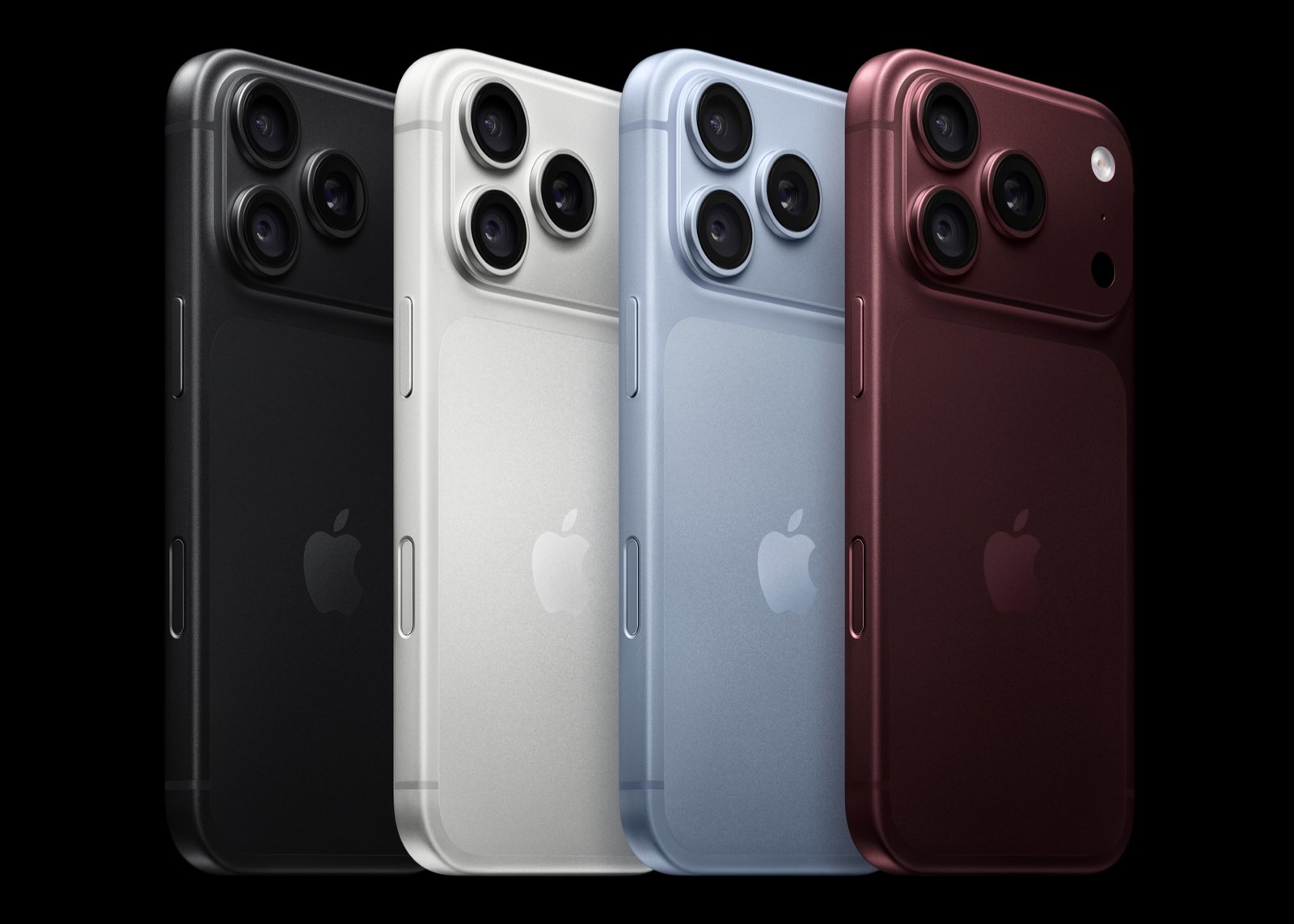
Apple announced both on September 9 and set availability for September 18. The 18 Pro is $1,199 with 256GB, $1,399 with 512GB, $1,799 with 1TB and $2,399 with 2TB; the Pro Max is $100 more at every tier. Tom’s Guide’s ranking entry for the Pro Max calls its $1,299 start “a price hike to the tune of $100.”
What the money buys, in Apple’s words. The main camera is a “48MP Fusion Main camera with variable aperture,” with four settings from f/1.48 to f/4.0, which Apple describes as “bringing aperture control to iPhone for the first time.” The A20 Pro chip is “built using the latest 2-nanometer process technology,” with a GPU Apple calls “up to 40 percent faster than A19 Pro.” Battery is “up to 36 hours of video playback on iPhone 18 Pro and up to 45 hours of video playback on iPhone 18 Pro Max,” and Apple says the 18 Pro “can also charge up to 50 percent in around 15 minutes.” That speed needs what Apple’s spec page calls a “60W-capable adapter or higher with Adjustable Voltage Supply (available separately)”; the phones “do not include a power adapter,” and Apple sells its 40W Dynamic Power Adapter with 60W Max for $39. The Pro also gains Apple Reference Image, a mode that stores an unalterable reference photo so an edited image can be visually compared against what the sensor saw; that feature has its own explainer.
What the labs found
The battery gains are real: small on the Pro Max, larger on the Pro. On Tom’s Guide’s test the 18 Pro Max lasted 18 hours 27 minutes, 33 minutes longer than the 17 Pro Max, which the site called “a modest 3.1% increase.” The 18 Pro lasted 16 hours 17 minutes, 56 minutes longer than the 17 Pro, which the site called “a 6.1% bump.” GSMArena, which runs its own test, gave the Pro Max an active-use rating of 19 hours 20 minutes against 17 hours 58 minutes for the 17 Pro Max, and gave the 18 Pro 16 hours 43 minutes. GSMArena reviewed the versions with a physical SIM slot, which it says have the smaller of the two battery sizes; the U.S. models are eSIM-only.
Apple’s charging claim held up on one of the two phones. GSMArena took the Pro Max to 50 percent in 15 minutes and to full in 55 minutes, against 1 hour 12 minutes for the 17 Pro Max. On the smaller 18 Pro it wrote “we weren’t able to get to 50% in 15 minutes,” recording 42 percent at that mark and a full charge in 1 hour 2 minutes. Both tests used a 67W Google charger, not Apple’s own adapter.
On the camera, Tom’s Guide writes that Apple’s low-light performance “is now even better,” and names one weakness: “We still fall short in zoom photography, with the Samsung Galaxy S26 Ultra still doing a better job with far-away subjects.”
Pick the Pro Max over the Pro for the screen and the battery: the 6.9-inch display against 6.3, 249 grams against 211, and 2 hours 10 minutes more on Tom’s Guide’s test. It also charged faster in GSMArena’s tests. Apple’s spec page lists one camera system and one A20 Pro chip for both models.
If you are on AT&T: the 18 Pro Max service fault
Apple told 9to5Mac on October 2: “We have identified an issue affecting a small number of iPhone 18 Pro Max users on the AT&T network that may cause a device to lose service and be unable to make calls.” Affected phones show SOS in the status bar and cannot reach AT&T’s network for calls, texts or data, 9to5Mac reports, and MacRumors writes that “Thousands of users complained about the issue across the Apple Support Community and other platforms.” Apple released iOS 27.0.1 and a carrier settings update, which it says “are meant to help prevent this issue from occurring.” They do not bring back a phone that has already lost service; 9to5Mac reports that those owners “will need a hardware replacement.” Apple said it has only observed the issue on the iPhone 18 Pro Max on AT&T, MacRumors reports, and it did not disclose the cause.
Apart from size and battery, one hardware difference matters here, in the U.S. only. Apple’s spec page lists an “Apple C2 cellular modem” for the 18 Pro and not for the Pro Max, and MacRumors reports that U.S. Pro Max models use Qualcomm’s Snapdragon X80 modem. MacRumors, comparing U.S. Pro Max models with the C2 versions sold elsewhere, adds: “It is unclear if this modem difference is a factor in this AT&T issue.” It also says “it sounds like Apple Stores will replace affected iPhone 18 Pro Max devices for free.”
What that means if AT&T is your carrier: 9to5Mac reports that the smaller 18 Pro “is unaffected by these AT&T connectivity issues,” and it has the same camera system and A20 Pro chip, so it is the cautious pick until Apple names a cause. If you buy the Pro Max anyway, install iOS 27.0.1 and the carrier settings update before you rely on the phone; 9to5Mac says the carrier update can be triggered by “going to Settings, choosing General, then About.” Apple’s statement urges the iOS update on every Pro Max owner: “We released iOS 27.0.1 earlier this week and strongly encourage all iPhone 18 Pro Max users to update now”. Nothing in that statement covers a Pro Max bought for another carrier and moved to AT&T later. Remember the lock, too: a phone financed through the AT&T Installment Plan stays locked to AT&T until it is paid in full, so a financed Pro Max cannot follow you to another carrier if the fault worries you later. What to do if a phone is already stuck on SOS is in the AT&T no-service story.
Is a renewed iPhone 17 Pro or Pro Max still worth it?
The iPhone 17 Pro Max is no longer the longest-lasting iPhone, and Apple no longer sells it. Tom’s Guide’s battery test gave it 17 hours 54 minutes and GSMArena’s active-use score came out at 17 hours 58 minutes, against 18 hours 27 minutes and 19 hours 20 minutes for the 18 Pro Max. MacRumors reported on September 9 that Apple “has discontinued the iPhone 17 Pro and iPhone 17 Pro Max,” and Apple’s new-iPhone store carries no tile for either; its certified refurbished store is the place to check for one. That is the pattern 9to5Mac predicted going into the 2025 event: “Rather than giving its year-old Pro models a price drop, Apple just stops selling them altogether.”
So the 17 Pro and Pro Max are a renewed-market proposition, and what you give up is mainly this: 33 minutes of Tom’s Guide battery on the Pro Max and 56 minutes on the Pro, the variable-aperture camera, and charging speed, where GSMArena’s full charge took 55 minutes on the 18 Pro Max against 1 hour 12 minutes on the 17 Pro Max. A renewed one is worth buying only if its price sits well below the $1,199 or $1,299 of the new model. Check the seller’s grade and return window. Apple’s trade-in credit, which its release puts at “$175 to $885 (U.S.)” for an iPhone 13 or later depending on the model you hand in, is Apple’s own program, so price a new 18 Pro with your trade-in before you pay for a renewed 17 Pro.
If you already own a 17 Pro Max, keep it. Tom’s Guide’s ranking puts it this way: “If you’ve still got an iPhone 17 Pro Max, you’re not going to find much of a reason to upgrade.”
Cheapest new iPhone: iPhone 17e
At $699 the iPhone 17e is the cheapest new iPhone, and its price does not change with a carrier; Apple lists the same $699 whether you activate on AT&T, T-Mobile or Verizon or choose “Connect to any carrier later.” It carries the A19 chip with a 4-core GPU, a 6.1-inch OLED display, 256GB of storage, and a single 48MP main camera whose 2x is a 12MP crop that, unlike the 17’s, Apple does not call “optical-quality.” Apple’s battery claim is up to 26 hours of video playback. Tom’s Guide measured 12 hours 35 minutes, 12 minutes behind the iPhone 17 and 22 minutes ahead of the pricier iPhone 16. Its review notes that the 17e figure “is only based on one battery drain pass,” so treat its few-minute gaps to the 17 and the 16 as close to a tie.
What $200 to $230 less than the iPhone 17 costs you: the 17e’s display has no ProMotion (Apple lists no adaptive refresh rate for it), and its spec page lists 800 nits of typical brightness against 1,000 for the 17, which also has the Dynamic Island and an always-on display. It also drops the ultra wide camera and charges wirelessly at 15W rather than 25W. Little of that matters if you are replacing an old phone on a budget; most of it matters if you have used a 120Hz screen.
The thin one: iPhone Air
The iPhone Air is 5.64 mm thick and 165 grams, the lightest phone Apple sells, with a 6.5-inch 120Hz display and the A19 Pro chip. It costs $1,099 with 256GB, $100 more than before September 9.
It is a design purchase, not a value one. Tom’s Guide measured 12 hours 2 minutes, the shortest result among the current iPhones on its list (the Duo’s 13:20 is from a redesigned version of the test) and 45 minutes behind the $929 iPhone 17. Apple’s own claim is up to 27 hours of video playback, three hours short of its claim for the iPhone 17, and Apple sells a $99 MagSafe Battery that raises the claim to 40 hours. It has one rear camera.
Buy it because you want the thinnest iPhone that does not fold, and know what you are trading. (The opened Duo is thinner still, at 5.2 mm.) SellCell’s December 2025 trade-in data, reported by MacRumors, put the Air at 44.3 percent depreciation from its launch price ten weeks after release, against 34.6 percent for the iPhone 17 series.
The foldable: iPhone Duo
Apple calls the iPhone Duo “the first foldable iPhone,” with a 7.6-inch inner display and a 5.4-inch outer display that “delivers 90 percent of the screen area of iPhone 18 Pro.” It starts at $1,999 with 256GB and runs to $2,199, $2,599 and $3,199 for 512GB, 1TB and 2TB. Pre-orders opened October 16 and it went on sale October 23.
Apple’s battery claim comes in parts because the phone has two screens: “up to 31 hours of video playback when using the inner display, up to 44 hours of video playback when using the outer display, and up to 24 hours of usage per charge when both displays are used equally.” It uses Touch ID in the side button rather than Face ID, weighs 254 grams, and is 5.2 mm thick open and 11.3 mm closed. The rear cameras are a 48MP main and a 48MP ultra wide; there is no dedicated telephoto lens.
Who it is for: someone who already wanted a foldable and waited for Apple’s. The reviews are in: Tom’s Guide now ranks it its best foldable overall, and its review calls it “the best designed foldable phone I’ve ever tested,” and PCMag says it delivers “the best hardware, performance, and battery life of any foldable phone on the market.” The costs: it is heavy, at 254 grams, though the 18 Pro Max weighs 249, and Tom’s Guide says that while fully updated apps look great, “non-optimized apps do not.” Expect to wait for one, since Tom’s Guide says it “is backordered for many until December or January.” The iPhone Duo story has each outlet’s battery results, what a Duo repair costs covers AppleCare+ against the carrier plans, and the top smartphones page compares it with Samsung’s and Motorola’s foldables. If your choice is between the Duo and the 18 Pro Max, the iPhone Duo vs iPhone 18 Pro Max comparison sets out both reviewers’ battery tests, the camera gap and the repair costs side by side.
Why the iPhone 16 is the one to skip
Apple still sells the iPhone 16, and it should not be on your list. It costs $829 with 128GB of storage, or $799 with carrier activation; the iPhone 17e costs $699 with 256GB. It also rose $100 on September 9, MacRumors reported, from the $699 that now buys a 17e. The 16 runs the older A18 chip and its display is the same 6.1-inch size as the 17e’s, with no ProMotion on either. It does not last longer either: 12 hours 13 minutes on Tom’s Guide’s test against 12 hours 35 minutes for the 17e. Its advantages over the 17e are the ultra wide camera, the Dynamic Island, a brighter 1,000-nit panel, 25W MagSafe and the Camera Control button. That is not worth $100 to $130 and half the storage. Apple’s store does advertise carrier trade-in credits on the 16, as it does on the 17e and the 17, so if a carrier deal is how you are buying, compare the offers on those two before taking one on the 16.
What changed on September 9, and what it costs you
Three things moved, and all three change the math.
Prices rose on the carried-over phones. MacRumors reported on September 9 that Apple “has raised the prices of the existing iPhone 16, iPhone 17, iPhone Air, and iPhone 17e on its online store,” each by $100: the 16 to $799, the 17e to $699, the 17 to $899 and the Air to $1,099. Those are still the starting prices on the store as of October 22. Neither September 9 iPhone release mentions the increases.
The 17 Pro vanished. Apple discontinued the 17 Pro and 17 Pro Max the same day, MacRumors reported, the pattern 9to5Mac had described a year earlier, so last year’s flagship is now a renewed-market phone.
No base iPhone 18 arrived. Apple’s iPhone releases on September 9 cover the 18 Pro, the 18 Pro Max and the Duo; no standard iPhone 18 was announced. If you were waiting for a cheaper new iPhone, the wait has no announced end; Tom’s Guide writes that a base iPhone 18 and an iPhone 18e “are expected to launch in early 2027,” which is an outlet’s expectation and not an Apple date. Until then the iPhone 17 is the phone you were waiting for, at a higher price.
The traps
- Storage tiers cost more than the phone’s value gap. The step from 256GB to 512GB is $200 on the iPhone 17, 17e, Air and 18 Pro, and the 2TB 18 Pro Max is $2,499, more than a base iPhone Duo. Buy the storage you need, and put the difference toward iCloud if you run out.
- Starting prices are carrier prices on two models. The iPhone 17 and iPhone 16 tiles include a $30 discount that requires carrier activation; the 17e, Air, 18 Pro and Duo have no such discount and cost the same either way.
- Trade-in is worth checking before you shop renewed. Apple’s release offers “$175 to $885 (U.S.) in credit” for an iPhone 13 or later, depending on the model. As of October 22 its store also advertises carrier credits on a new iPhone after trade-in of up to $1,200 at AT&T, $1,000 at T-Mobile and $840 at Verizon; those are store-wide maximums, and the cheaper phones’ own pages show less, such as up to $799 on the iPhone 16. Read the carrier terms before you count on one: a phone financed through a carrier’s installment plan is locked to that carrier until it is paid in full.
- Renewed is not refurbished by Apple. Apple’s own certified refurbished store sells products “backed by a one-year warranty,” so check it before paying a renewed price.
- Support length is not a tiebreaker, but features can be. None of the Apple pages cited here states a per-model support window, so do not buy a more expensive phone for support alone. Features are a different matter: Tom’s Guide writes that iOS 27 “comes pre-installed on the iPhone 18 Pro and Pro Max” and, about updating the 17 Pro and Pro Max, that “some features aren’t available,” without listing them. If one new iOS feature is your reason to buy, check Apple’s requirements for it first. The Duo “will be available with iOS 27.1.”
- A battery claim is not a battery result. Apple’s video-playback hours run from 22 on the iPhone 16 to 45 on the 18 Pro Max; Tom’s Guide’s web test runs from 12 hours 2 minutes to 18 hours 27 minutes across the six current non-folding iPhones (the Duo’s 13:20 is from a redesigned version of the test). Compare measured numbers with measured numbers.
Frequently asked questions
Which iPhone is the best value in 2026?
The iPhone 17 at $929, or $899 if you activate with a carrier at checkout. It has the 120Hz display and 256GB base storage of the Pro models and a measured battery result of 12 hours 47 minutes, and it is at least $270 less than the iPhone 18 Pro. If $929 is too much, the $699 17e is the answer and the iPhone 16 is not.
Is the iPhone 18 Pro worth it over the iPhone 17 Pro?
Not as an upgrade from one to the other. Tom’s Guide measured 16 hours 17 minutes for the 18 Pro against 15 hours 21 minutes for the 17 Pro, a gain of 56 minutes, and the main addition is the variable-aperture camera. Apple no longer lists the 17 Pro new, so for a first-time Pro buyer the comparison is a new $1,199 phone against a renewed one. If you own a phone several generations older, the 18 Pro is the one to buy new.
Is the iPhone 18 Pro Max safe to buy on AT&T?
Not with certainty. Apple says the service fault affects “a small number” of iPhone 18 Pro Max users on AT&T, while MacRumors reports that thousands of users complained. A phone that loses service cannot be fixed with software and has to be replaced; iOS 27.0.1 and a carrier settings update, in Apple’s words, “are meant to help prevent this issue from occurring.” Apple did not disclose the cause, MacRumors reported on October 2. If you want no part of that risk, the smaller iPhone 18 Pro, which 9to5Mac reports is unaffected, is the alternative on AT&T. The AT&T no-service story has what owners should do.
Should you wait for the base iPhone 18?
Apple has not announced one. Its September 9 releases cover the 18 Pro, the 18 Pro Max and the iPhone Duo only. Tom’s Guide writes that a base iPhone 18 and an iPhone 18e “are expected to launch in early 2027,” which is an outlet’s expectation, not an Apple date. Waiting already cost iPhone 17 buyers $100 on September 9, so if you need a phone now, buy the 17.
Which iPhone has the best battery life?
The iPhone 18 Pro Max, on claims and on tests. Apple rates it at up to 45 hours of video playback, and it lasted 18 hours 27 minutes on Tom’s Guide’s test and earned a 19 hours 20 minutes active-use rating at GSMArena. Among the iPhones Apple sells, the iPhone 18 Pro is second at 16 hours 17 minutes, and the four cheaper models all land between 12 hours 2 minutes and 12 hours 47 minutes.
Is the foldable iPhone worth the money?
For someone who wants a foldable, the first reviews say yes. Tom’s Guide now ranks the $1,999 Duo its best foldable overall and PCMag gave it an Editors’ Choice. The trade-offs are real: it has no telephoto lens, Apple’s claimed battery on the big screen is shorter than the 18 Pro’s, it is heavy (though only 5 grams heavier than the 18 Pro Max), and Tom’s Guide says it “is backordered for many until December or January.” If you want the longest battery and a big screen that does not fold, the 18 Pro Max does that for $700 less.
Does the iPhone 17 have a 120Hz display?
Yes. Apple’s spec page lists “ProMotion technology with adaptive refresh rates up to 120Hz” for the iPhone 17, the same line as the Pro models. The iPhone 17e and iPhone 16 do not have it.
Sixty seconds to decide
You want a good iPhone and do not want to think about it: iPhone 17, $929. You want the cheapest new one: iPhone 17e, $699. You take a lot of photos and can afford it: iPhone 18 Pro, $1,199. You want the longest battery and the biggest screen that does not fold: iPhone 18 Pro Max, $1,299, unless AT&T is your carrier and you would rather wait for Apple to name the cause of the service fault. You want it thin: iPhone Air, $1,099, with its eyes-open battery trade. You want the foldable: iPhone Duo, $1,999, which the first reviews rate as the best foldable, if you can wait for stock. You want the iPhone 16: you do not, at $829, when the 17e is $699.
For the Android side of the decision, the cross-brand ranking covers Samsung, Google and the measured foldables. And if the phone comes with a watch, the Apple Watch guide applies the same approach to the wrist.
Sources (29)
- apple.com Apple Newsroom: Apple debuts iPhone 18 Pro and iPhone 18 Pro Max
- apple.com Apple Newsroom: Apple unveils iPhone Duo
- apple.com Buy iPhone
- apple.com iPhone 18 Pro buy page
- apple.com iPhone Duo buy page
- apple.com iPhone 17 buy page
- apple.com iPhone 17e buy page
- apple.com iPhone Air buy page
- apple.com iPhone 16 buy page
- apple.com iPhone 18 Pro tech specs
- apple.com iPhone Duo tech specs
- apple.com iPhone 17 tech specs
- apple.com iPhone 17e tech specs
- apple.com iPhone Air tech specs
- apple.com iPhone 16 tech specs
- tomsguide.com Best phones 2026, tested
- gsmarena.com iPhone 17 Pro Max review
- 9to5mac.com products Apple will discontinue after the iPhone 17 event
- macrumors.com iPhone resale value data from SellCell
- tomsguide.com iPhone 18 Pro Max and 18 Pro battery life tested
- tomsguide.com Apple iPhone Duo review
- pcmag.com Apple iPhone Duo review
- tomsguide.com Best iPhones in 2026
- gsmarena.com iPhone 18 Pro Max review
- gsmarena.com iPhone 18 Pro review
- 9to5mac.com Apple confirms iPhone 18 Pro Max AT&T cellular issues
- macrumors.com Apple says affected iPhone 18 Pro Max must be replaced
- macrumors.com Apple raises prices of iPhone 16, iPhone 17, iPhone Air and iPhone 17e
- tomsguide.com iPhone 17e review



🦋 Discussion on Bluesky
Discuss on Bluesky