


Tesla’s own online shop sells every pick below in versions made for specific model years, though a few cars have no Tesla version of a piece (the fit table shows which), and a cordless inflator is the one third-party item worth adding. Prices are from Tesla’s US shop on October 14, 2026.
- All-weather floor liners: $225 to $240 for the front and second-row set, depending on model and year.
- A tire inflator: Tesla’s Air Compressor + Tire Repair Kit 3.0 costs $110. The cordless alternative is the Slime Cordless Pro Power, Car and Driver’s best-overall pick among portable inflators.
- A glass-roof sunshade: $105 for a Model Y and $115 for the Model 3’s front-and-rear set. The shade for 2025 and newer Model Ys is for Premium and Performance trims only.
- Center console trays: $30 to $40.
- Charging gear: nothing extra for most public Level 2 stations. Tesla’s US shop says its J1772 adapter for public chargers “is included with every Tesla vehicle delivery.”
Skip the screen protector. The Model 3 and Model Y owner’s manuals both say “Do not apply a screen protector on the touchscreen,” and any damage one causes “is not covered by the warranty.”
What are good gifts for a Tesla owner?
The picks above also work as gifts for someone with a Model 3 or Model Y. Here they are by budget, at the prices in Tesla’s US shop on October 14, 2026.
- Under $50: center console trays, $30 to $40 depending on the car.
- About $105 to $115: a glass-roof sunshade, $105 for a Model Y or $115 for the Model 3 set, or Tesla’s Air Compressor + Tire Repair Kit 3.0 at $110.
- $225 to $240: a set of all-weather floor liners.
Find out a few things before you order: the model, the model year and, for a 2025 or newer Model Y, the trim and whether it is a Model Y L, which Tesla’s newest liners and roof sunshade both exclude. For trays on a 2017 to 2023 Model 3 or a 2020 to 2024 Model Y, you also need to know the car has the updated “refresh” console. Tesla sells the liners, sunshades and trays in versions for specific cars, and the fit table below shows which version goes with which. Even the tire kit comes in two styles, one labeled “Model Y” and one labeled “Model S,X,3,Y Premium and Performance,” and Tesla’s page says no more than those labels about which cars each fits.
If you cannot find out the year without giving the surprise away, the cordless Slime inflator is the safer pick. It is a general tire inflator, which Slime says “Inflates a standard car tire from flat to full in 3 minutes,” so there is no Tesla version to match.
One thing not to wrap is a screen protector. Both owner’s manuals say “Do not apply a screen protector on the touchscreen.”
Which version fits your Tesla
Tesla’s liners, sunshades and trays come in versions by model and production year. Some pieces fit more than one car, a few cars have no Tesla version of a piece, and the product pages list which cars each one fits. Check the year before you order.
| Accessory | Model 3, 2017 to 2023 | Model 3, 2024 and newer | Model Y, 2020 to 2024 | Model Y, 2025 and newer |
|---|---|---|---|---|
| All-weather interior liners | $225 | $225 | $225 | $240 (not Model Y L) |
| Glass-roof sunshade | $115 set, 2021 to 2023 cars only | $115 set | $105 | $105, Premium and Performance only, not Model Y L |
| Center console trays | $35, “refresh” consoles only | $35 | $35, “refresh” consoles only | $30 (other trims) or $40 (Premium and Performance) |
The tray set for older cars fits only the updated center console Tesla calls the “refresh” console, and the product page has photos to help you tell which one you have. The same $40 Premium and Performance set also fits Model Y L Premium cars built in 2026 or later.
Floor liners: the first thing to buy
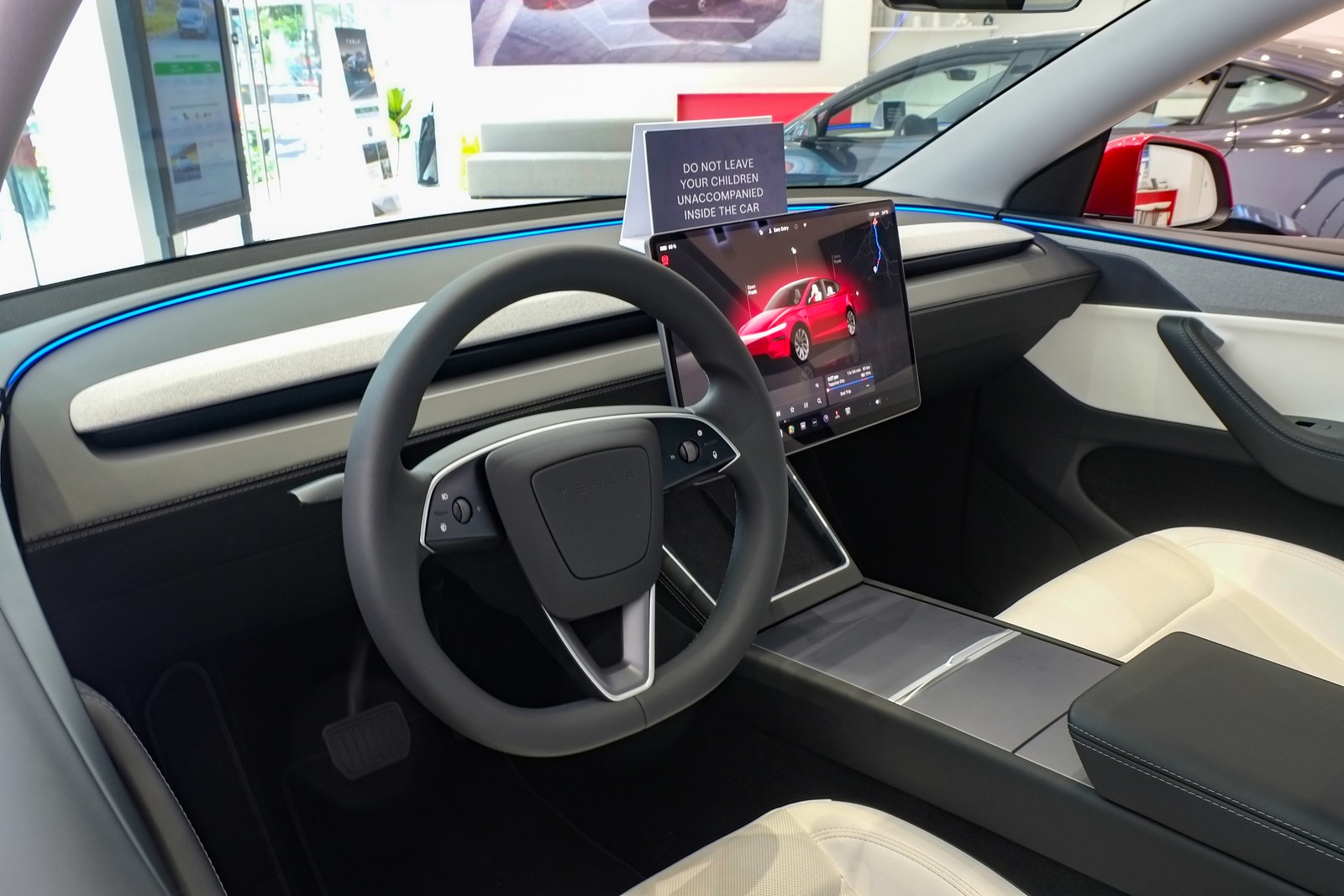
Tesla’s all-weather liners are rubber-like trays with raised walls that help protect the carpet and make cleanup easy. The set covers both front footwells and the second row. The 2025 and newer Model Y set is “secured in place with integrated cleats to prevent slipping.” Matching liners for the front trunk and the rear cargo area are sold separately, from $55 to $220 depending on the piece and the car.
Both manuals recommend “genuine Tesla floor mats” to protect the carpet, but how you lay any mat matters more for safety. Both manuals say to make sure “the driver’s floor mat is securely fastened, and never place an additional floor mat on top of it,” to avoid “potential interference with a foot pedal.” Automatic emergency braking is one reason: “The brake pedal may move downward abruptly during automatic braking events,” and an extra mat can get in its way. Mats “should always rest on top of the vehicle carpeting surface and not on another floor mat or other covering,” so if your car has carpet mats, take them out before you lay the liners.
See the liners at Tesla: Model Y, 2025 and newer · Model Y, 2020 to 2024 · Model 3, 2024 and newer · Model 3, 2017 to 2023
A tire inflator for flats and cold mornings
Tesla’s manual calls its tire repair kit “optional,” so do not assume one is in the car. An inflator earns its place in cold weather too: Tesla says tires “will lose one PSI for every 10° F (6° C) drop in outside temperature,” and if the tire pressure warning light comes on, “inflate the tires before driving.” The tire pressure guide explains where to find your car’s pressure (the label on the driver’s door pillar) and why the cold-morning alert comes on.
Tesla’s Air Compressor + Tire Repair Kit 3.0 ($110) is a compressor plus a bottle of sealant. You plug it into the car’s 12-volt socket, attach the hose and press the power button. The Model Y manual lists that outlet as “If Equipped,” so check that the car has one. It comes in two styles, “Model Y,” which adds an extension cable, and “Model S,X,3,Y Premium and Performance.” The page says no more than those labels about which cars each fits, so ask Tesla if your car is not clearly one or the other. The sealant is a get-you-home fix: Tesla says it seals holes up to 6 millimeters (about a quarter inch) in the tread, not the sidewall, and says to see a tire shop within 62 miles. For a sidewall puncture its advice is “contact roadside assistance.” The product page also limits the compressor to 30 minutes of running, followed by 60 minutes of rest. Follow the instructions that come with your kit if they give a shorter limit.
Stick with Tesla’s sealant if you use sealant at all. The manual warns that if a tire was repaired “using a different tire sealant than the one available from Tesla” and low pressure is then detected, “it is possible that the tire sensor has been damaged.” Even with Tesla’s kit, the product page says the damaged tire and its sensor should be replaced afterward, and that cost is not covered by Tesla’s warranty.
Slime Cordless Pro Power (check price on Amazon) is the pick if you only need air. It runs on a built-in rechargeable battery, shows the pressure on a digital screen and stops by itself at the pressure you set, according to Slime. Car and Driver named it the best overall portable tire inflator after timing each model from a 10 pounds per square inch (psi) start up to 30 and then 45 psi, which it calls “the approximate range for typical passenger-vehicle tires.” Car and Driver’s one complaint was battery life: after a single 10-to-45 psi test, the readout showed half its charge left. Slime includes a backup 12-volt cord, but Tesla “recommends that you do not plug any non-Tesla accessories” into the car’s low-voltage power outlet, so keep the battery topped up instead; Slime says to recharge it after each use and at least every four months.
A sunshade for the glass roof
Tesla’s own advice for hot days: “Use a sun shade (available on the Tesla Shop) if you have to park outside in the sun.” Tesla’s clip-in shades are mesh on a folding frame and pack into a zippered pouch when you take them down. Tesla rates the 2025 and newer Model Y roof shade at blocking 80% of visible light, and the 2020 to 2024 Model Y shade and the Model 3 shade at 66%.
Check the fit first. Tesla lists the newest Model Y roof shade for Premium and Performance cars built in 2025 or later, excluding the Model Y L, and the Model 3 set for cars built in 2021 or later. Other 2025 and newer Model Y trims can still get the $70 rear-liftgate shade on the same page, which Tesla lists for every 2025 and newer Model Y except the Model Y L.
See the sunshades at Tesla: Model Y Premium and Performance, 2025 and newer · Model Y, 2020 to 2024 · Model 3 set
Center console trays
Trays add bins to the center console, which Tesla pitches as keeping “frequently accessed items handy.” The $40 set for the 2025 and newer Model Y Premium and Performance has three bins, with a sliding top tray at the front. Other 2025 and newer Model Y trims take a different, $30 tray that Tesla says does not fit Premium and Performance cars.
See the trays at Tesla: Model Y Premium and Performance, 2025 and newer · other 2025 and newer Model Y trims · Model 3, 2024 and newer · older cars with the refresh console
Do wheel covers add range?
Yes, by a few percent. Both owner’s manuals list “Install aero covers (if equipped) to reduce wind resistance” among their tips to maximize range.
Car and Driver measured how much. It drove its long-term Model 3 Long Range Dual Motor, on 18-inch wheels, around a five-mile oval at steady speeds, with and without Tesla’s factory aero covers, at 44°F and with the tires at the door-placard 42 psi.
| Steady speed | Covers off | Covers on | Energy saved |
|---|---|---|---|
| 50 mph | 258 Wh/mile | 250 Wh/mile | 3.1% |
| 70 mph | 318 Wh/mile | 310 Wh/mile | 2.5% |
| 90 mph | 424 Wh/mile | 405 Wh/mile | 4.5% |
Wh/mile is watt-hours per mile, the energy the car uses to go one mile. Averaged over the three speeds, Car and Driver found the covers 3.4% more efficient, which it called “a sizable gain in the automotive world,” worth “a boost in range of up to 10 miles,” and concluded that “owners should think twice before ditching them.” That was one Model 3, in a test Car and Driver published in December 2019, on 18-inch wheels with the original Aero covers, a part Tesla’s shop now lists for 2017 to 2023 Model 3s. Tesla’s shop sells the covers for newer cars as different parts, the Photon cover for 2024 and newer Model 3s and the Aperture cover for 2025 and newer Model Ys, and Car and Driver’s figures are not a measurement of those. Nor are they a measurement of any aftermarket cover.
If a cover cracks or goes missing, Tesla’s US shop sold single replacements on October 14, 2026: $60 for the 18-inch Photon cover (2024 and newer Model 3), $60 for the 18-inch Aero cover (2017 to 2023 Model 3, in “Pre-Refresh” and “Refresh” styles), $60 for the 18-inch Aperture cover (2025 and newer Model Y), $70 for the 19-inch Crossflow cover (Model Y) and $70 for the 19-inch Gemini cover (2020 to 2024 Model Y, in “Gemini Light” and “Gemini Dark” styles). For owners who want the wheel design under the covers on show, Tesla sells $80 cap kits for the Model 3’s 18-inch Photon and Aero wheels: four snap-on center caps with “integrated lug nut covers.” The Model Y’s 19-inch Crossflow and Gemini wheels have $80 cap kits too. Running without covers is the setup Car and Driver measured against.
The covers do have to come off sometimes. The Model 3 manual says that if your car has them, “you must remove them to access the lug nuts,” and both manuals say to remove them before fitting snow chains (more on chains below).
If you fit a different set of wheels, such as a winter wheel-and-tire set, tell the car. Both manuals say to update the wheel configuration under Controls > Service > Wheel & Tire > Wheels, and note that “Changing your vehicle’s wheel configuration can impact range estimates, tire pressure warning levels, and vehicle visualization.” The manuals tie that setting to installing or swapping wheels; neither one mentions covers in it.
Snow chains: only the ones Tesla lists
If you drive to the mountains in winter, chains are one add-on where Tesla names the exact brand and size. Both manuals list chains Tesla “has tested and approved,” say they “should only be installed on the rear tires,” and warn that damage from other chains “is not covered by the warranty.”
| Car and wheel size | Chain Tesla lists |
|---|---|
| Model 3, 18-inch | König CG-9 102 |
| Model 3, 19-inch | König CG-9 103 |
| Model 3, 20-inch | König K-Summit K34 |
| Model Y, 18-inch | König CG-9 size 105 |
| Model Y 5- or 7-seat, 19- or 20-inch | König XG-12 Pro size 252 |
| Model Y 6-seat 19-inch, and all 21-inch | König K-Summit XXL K66 |
The table comes from the current Model 3 and Model Y manuals, and older cars can differ, so check the manual on your car’s touchscreen; the Model Y manual itself says to check it “for updated information on tire chains.” The Tesla snow guide covers the snow settings and chain rules for the current Model 3, Model Y, Model S and Model X.
Tesla’s shop lists chain sets by wheel size: $175 for a Model 3 18-inch or 19-inch set, $420 for the 2017 to 2023 Model 3 Performance 20-inch set, $250 for the Model Y 19-inch or 20-inch set and $575 for the Model Y 21-inch set. The $250 set is the König XG-12 Pro 252, the chain the manual lists for 5- and 7-seat cars, not 6-seat ones; the shop page itself does not mention seat count. No Model Y 18-inch chain set was listed on October 14, 2026. The shop also sells snow socks for $95 to $145, depending on the car and wheel size; the manual’s list above names chains, not socks.
Before you use chains, both manuals say to remove any wheel covers, never to put chains on summer tires, and to stay under 30 mph (48 km/h). Both manuals add “Never deflate your tires to put on tire chains.” They also note that chains “are prohibited in some jurisdictions,” so check local rules.
Charging gear: check what you have first
For public Level 2 charging, Tesla’s shop says the J1772 adapter “is included with every Tesla vehicle delivery,” so check that a used car still has its adapter, and Tesla says it works with “most Level 2 public charging stations.”
Tesla’s $300 Mobile Connector is worth it only if you will charge from a wall outlet. It comes with adapters for a standard outlet (NEMA 5-15) and a NEMA 14-50 outlet. Tesla rates it at “up to 3 miles of range per hour with the NEMA 5-15 Adapter or up to 30 miles of range with the NEMA 14-50 Adapter, depending on your vehicle.” (NEMA stands for the National Electrical Manufacturers Association, which sets the outlet shapes.) Wirecutter, which has tested home chargers on a Model 3 and two Model Ys since 2022, did not pick it, noting it “supports only up to 32 A charging” and carries a one-year warranty unless it came with the car.
To choose between that cable and Tesla’s wall unit, see the Mobile Connector or Wall Connector guide. For a permanent setup, the electric vehicle (EV) charger installation cost guide covers breakers, panels and plug-in versus hardwired chargers. If home charging already seems slow, see why a Tesla charges slowly.
What to skip: the manual’s list
Several popular add-ons are things the Model 3 and Model Y owner’s manuals both say to avoid.
| Skip this | What Tesla’s manuals say |
|---|---|
| Screen protector | “Do not apply a screen protector on the touchscreen.” It can cause “phantom inputs” and static damage, and damage it causes is not covered by the warranty. |
| Seat covers | “Do not use seat covers on Model Y. Doing so could restrict deployment of the seat-mounted side airbags if a collision occurs.” The Model 3 manual says the same. |
| Steering-wheel covers and seat cushions | Named in the airbag warning: “steering wheel covers, decals, seat cushions, pillows, etc.” |
| A second mat on top of the first | “never place an additional floor mat on top of it” |
| Clip-ons on the headliner | “aftermarket add-ons such as sunglass holders may reduce the accuracy” of the system that decides whether the passenger airbag is on |
| A non-Tesla car cover while charging | It “can prevent the Battery from being adequately cooled during charging.” |
| Plug-in 12-volt gadgets and inverters | Tesla “recommends that you do not plug any non-Tesla accessories, including power inverters,” into the low-voltage power outlet |
| Rain-repellent (hydrophobic) coating on the windshield | Apply it “only to the side and rear windows, not the front windshield,” because doing so “may affect the visibility of the Self-Driving cameras” |
The headliner rule is in both current manuals, which say “Do not block or obstruct the cabin radar” and list “modifications to the headliner” among the things that can throw off the system that decides whether the front passenger airbag is on.
A child’s car seat has rules of its own on the same airbag pages. Both manuals say “The safest place to seat infants and young children is in a rear seating position.” The guide to car seats in a Tesla goes model by model and row by row.
One item you may already have: Dashcam and Sentry Mode recordings need a Universal Serial Bus (USB) drive, and both current manuals say the glovebox port “is equipped with a USB flash drive.” Look there before you buy one. Older cars can differ, and the Tesla dashcam USB drive guide covers which port records on each car and which replacement drives work.
Does an aftermarket accessory void the warranty?
Not in so many words. The manual says: “Any damage caused by using or installing non-approved parts, or by performing non-approved modifications, is not covered by the warranty.” So the risk is tied to the damage the part causes. A screen protector that leads to a touchscreen fault, or non-Tesla sealant that ruins a tire sensor, is the kind of case that sentence covers.
Tesla accessory questions
What are the best Tesla Model Y accessories? The same four picks, in the version made for your car. For a 2025 or newer Model Y, Tesla’s liners are $240, the glass-roof sunshade is $105 (Premium and Performance trims only) and the console trays are $30 or $40 depending on trim. Tesla does not list those liners or that sunshade for the Model Y L. For a 2020 to 2024 Model Y, the liners are $225, the sunshade is $105 and the trays are $35 for cars with the “refresh” console. The fourth pick is a tire inflator: Tesla’s $110 tire repair kit, which comes in two styles, or the cordless Slime; the inflator section explains which to choose. Those are Tesla’s US shop prices on October 14, 2026. Check your car against the fit table before you order.
What are the best Tesla Model 3 accessories? The same four picks. For a 2024 or newer Model 3, Tesla’s liners are $225, the front-and-rear sunshade set is $115 and the console trays are $35. For a 2017 to 2023 Model 3, the liners are also $225, the $115 sunshade set is for 2021 to 2023 cars only, and the $35 trays fit cars with the “refresh” console. The fourth pick is a tire inflator: Tesla’s $110 tire repair kit, in the style the inflator section points you to, or the cordless Slime. Those are Tesla’s US shop prices on October 14, 2026.
What is a good gift for a new Tesla owner? For a Model 3 or Model Y, any of this page’s four picks: console trays ($30 to $40), a glass-roof sunshade ($105 or $115), Tesla’s tire repair kit ($110) or all-weather floor liners ($225 to $240), at Tesla’s US shop prices on October 14, 2026. Check the car’s model, year and trim against the fit table first, because Tesla sells most of them in versions for specific cars. If you cannot find those out, the cordless Slime inflator has no Tesla version to match.
Does a Tesla come with a tire repair kit? Tesla’s manual describes it as “an optional tire repair kit available from Tesla,” and the Tesla Shop sells it for $110.
Do Tesla wheel covers improve range? Yes, by a few percent. In a Car and Driver track test published in 2019, a Model 3 on 18-inch wheels with the original Aero covers used 3.4% less energy on average across 50, 70 and 90 mph than with the covers off, worth up to 10 miles of range. That was one car with one cover design; newer Tesla covers and aftermarket covers were not part of the test. Both owner’s manuals list installing aero covers among their tips to maximize range. The wheel cover section has the figures at each speed and Tesla’s replacement prices.
Can you put a screen protector on a Tesla touchscreen? Tesla says no. Both the Model 3 and Model Y manuals warn it can cause phantom touches, slow response and static damage, and that the resulting damage is not covered by the warranty.
Are seat covers safe in a Tesla? Both the Model 3 and Model Y manuals say not to use them, because a cover “could restrict deployment of the seat-mounted side airbags.”
Do you need to buy a charger with a new Tesla? Not for most public Level 2 stations, since Tesla’s US shop says the J1772 adapter is included with every delivery. For home, it depends on your outlet; Tesla’s Mobile Connector costs $300 and comes with adapters for a standard outlet and a NEMA 14-50 outlet.
How should you clean a Tesla screen? Use a soft, lint-free screen cloth, and turn on Screen Clean Mode (Controls > Display > Screen Clean Mode) so wiping does not press buttons. The manual says not to use glass cleaner, hand sanitizer, wet wipes or a “recently washed microfiber.”
Sources (44)
- shop.tesla.com Tesla Shop: Model Y All-Weather Interior Liners
- shop.tesla.com Tesla Shop: Model 3 All-Weather Interior Liners
- shop.tesla.com Tesla Shop: 2020-2024 Model Y All-Weather Interior Liners
- shop.tesla.com Tesla Shop: 2017-2023 Model 3 All-Weather Interior Liners
- shop.tesla.com Tesla Shop: Model Y Glass Roof and Liftgate Sunshades
- shop.tesla.com Tesla Shop: 2020-2024 Model Y Sunshades
- shop.tesla.com Tesla Shop: Model 3 Sunshade Bundle
- shop.tesla.com Tesla Shop: Model Y Center Console Tray
- shop.tesla.com Tesla Shop: Model Y Premium and Performance Center Console Trays
- shop.tesla.com Tesla Shop: Model 3 Center Console Trays
- shop.tesla.com Tesla Shop: Center Console Trays for 2017-2023 Model 3 and 2020-2024 Model Y
- shop.tesla.com Tesla Shop: Air Compressor + Tire Repair Kit 3.0
- shop.tesla.com Tesla Shop: SAE J1772 Charging Adapter
- shop.tesla.com Tesla Shop: Model Y Vehicle Accessories
- shop.tesla.com Tesla Shop: Model 3 Vehicle Accessories
- shop.tesla.com Tesla Shop: Model Y 19"/20" Snow Chains
- shop.tesla.com Tesla Shop: Mobile Connector
- tesla.com Tesla Model Y Owner's Manual, Touchscreen
- tesla.com Tesla Model 3 Owner's Manual, Touchscreen
- tesla.com Tesla Model Y Owner's Manual, Airbags
- tesla.com Tesla Model 3 Owner's Manual, Airbags
- tesla.com Tesla Model 3 Owner's Manual, Cleaning
- tesla.com Tesla Model 3 Owner's Manual, Interior Electronics
- tesla.com Tesla Model Y Owner's Manual, Cleaning
- tesla.com Tesla Model Y Owner's Manual, Collision Avoidance Assist
- tesla.com Tesla Model Y Owner's Manual, Tire Care and Maintenance
- tesla.com Tesla Model 3 Owner's Manual, Tire Care and Maintenance
- tesla.com Tesla Model Y Owner's Manual, Interior Electronics
- tesla.com Tesla Model Y Owner's Manual, Parts and Accessories
- tesla.com Tesla Model Y Owner's Manual, Hot Weather Best Practices
- tesla.com Tesla Model Y Owner's Manual, Cold Weather Best Practices
- caranddriver.com Best Portable Tire Inflators, Tested
- slime.com Cordless Pro Power Tire Inflator
- nytimes.com Wirecutter: The Best EV Chargers for Home
- caranddriver.com Tesla Model 3 Aero Wheel Covers Efficiency Test
- tesla.com Tesla Model 3 Owner's Manual, Getting Maximum Range
- tesla.com Tesla Model Y Owner's Manual, Getting Maximum Range
- shop.tesla.com Tesla Shop: Model 3 18" Photon Wheel Cover
- shop.tesla.com Tesla Shop: 2017-2023 Model 3 Aero Wheel Cover
- shop.tesla.com Tesla Shop: Model 3 Photon Wheel Cap Kit
- shop.tesla.com Tesla Shop: 2017-2023 Model 3 Aero Wheel Cap Kit
- shop.tesla.com Tesla Shop: Model Y 18" Aperture Wheel Cover
- shop.tesla.com Tesla Shop: Model Y 19" Crossflow Wheel Cover
- shop.tesla.com Tesla Shop: 2020-2024 Model Y Gemini Wheel Cover



🦋 Discussion on Bluesky
Discuss on Bluesky